Article: How to Choose Wall Posters for a Rental Apartment
How to Choose Wall Posters for a Rental Apartment
How to Choose Wall Posters for a Rental Apartment
Choosing wall posters for a rental apartment means balancing what you love with what your space and lease allow. The right print can make standard white walls feel personal, give borrowed furniture a more intentional setting and move with you when your tenancy ends. The wrong size or hanging method can create unnecessary expense.
Start with the room, the wall surface and the artwork’s subject, rather than ordering a print and deciding where it belongs afterward. A few measurements and a clear display plan will help you choose something worth taking to your next home.
Start With Your Lease and Your Wall Surface
Before comparing artwork, check what your lease says about nails, picture hooks and adhesive products. Permission to decorate does not necessarily mean permission to drill. If the wording is unclear, ask your landlord or property manager and keep their response.
Next, identify the surface. Smooth painted drywall, textured plaster, wallpaper and exposed masonry need different approaches. Even removable adhesive products can lift weak paint or leave marks, so “renter-friendly” should never be treated as a guarantee of damage-free removal.
Existing picture rails or approved hooks may give you useful display options. Check their condition and suitability for the complete framed weight before relying on them.
Measure the Display Area Before Choosing a Size
The most useful starting point for wall posters is the space you can actually use, not the full width of the wall. Exclude door swings, switches, radiators and areas where furniture or people could knock the frame.
Measure the Frame, Not Just the Paper
A print’s listed dimensions usually describe the print, unless the product page says otherwise. A mat and frame increase the finished footprint.
For example, an 18-by-24-inch print with a 2-inch mat border needs a larger display area before you even account for the frame molding. Treat this as a measuring example, not an indication of sizes available for a particular product.
Over a sofa or sideboard, use the furniture as your visual reference. The artwork should feel connected to it without crowding nearby shelves or lighting. There is no single proportion that works for every apartment.
Test the Outline at Full Size
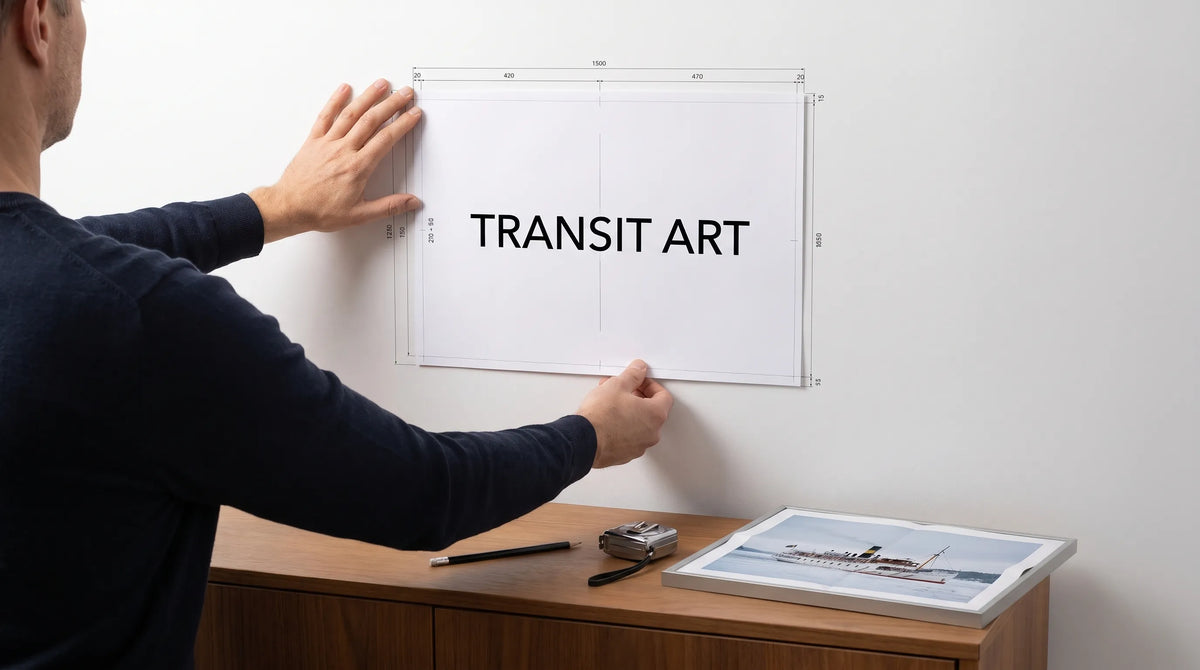
Cut a paper template to the proposed frame’s outer dimensions. Position it using a method suitable for your wall, then check it from the doorway, sofa and usual walking route.
Transit Art’s guide to making a full-size trial wall layout explains how to test scale before committing. This is especially useful when several small prints might otherwise become one large, expensive framing project.
What to Check Before Ordering Wall Posters
Product photography helps you judge composition, but a styled room image is not a reliable measuring tool. Read the dimensions and check whether framing, mats or other accessories are included rather than assuming everything pictured arrives together.
Look for clear information about paper, finish and available formats. A low-reflection surface can be helpful opposite a window, although the frame glazing also affects reflections. A screen cannot reliably show paper texture or reproduce every printed color, so avoid choosing artwork solely to match a precise paint shade.
Transit Art describes its prints as using gallery-quality materials and FSC-certified paper. FSC certification concerns responsible material sourcing; it does not, by itself, specify a print’s resistance to fading or the quality of a frame.
If you plan to add a mat, check the opening size as well as the frame size. The guide to choosing mat borders for paper posters can help you avoid an awkward crop or an unexpectedly oversized result.
Interior Design: Make the Artwork Belong Without Matching Everything
Rental interiors often come with fixed decisions: beige carpet, cool-toned flooring or kitchen cabinets you cannot repaint. Artwork can connect those elements rather than compete with them.
Choose a Mood Before a Color Scheme
Decide whether the room should feel restful, lively or quietly studious. Then assess the artwork’s contrast, detail and subject. A busy composition can energize a plain office, while a quieter scene may suit a bedroom with patterned bedding.
For a small living room, one clearly chosen focal piece often feels calmer than several unrelated purchases. Smaller prints can still work beautifully, especially when their frames and spacing give them a shared structure.
Use Frames as a Consistent Element
Matching frames can bring different subjects together without requiring identical artwork. Alternatively, use related wood tones to connect the art with existing furniture.
Keep future moves in mind. Standard-size frames and a restrained palette are usually easier to rearrange than a tightly fitted installation designed around one particular wall. Choose pieces you would still enjoy if your next apartment had a different layout.
A Maritime Subject With a Story: Winter break
For wall posters that bring transport history into a calm interior, a maritime subject offers an alternative to the more energetic associations of racing imagery.
Transit Art’s Winter break features S/S Storskär, the Swedish coastal vessel from 1908, at harbor in the Stockholm archipelago during winter. Its subject connects early twentieth-century shipbuilding with the quieter experience of a vessel resting between journeys.
The historical appeal lies in the relationship between engineering and place. A coastal ship is part of a working transport network, but it also carries associations with waterfront towns, seasonal travel and familiar shorelines. That combination gives maritime enthusiasts something more personal than a purely decorative nautical motif.
For a rental living room or home office, the print can introduce a specific story without requiring the whole room to follow a nautical theme. Let the actual product image guide your supporting colors rather than assuming every boat artwork needs blue accessories. Simple framing and uncluttered surroundings will give the vessel room to hold attention.

Choose a Hanging Method for the Complete Framed Weight
Before hanging wall posters, weigh the finished assembly, including the frame, glazing, backing and print. Paper size alone tells you very little about the load a fixing must support.
| Display method | When it may suit a rental | What to check first |
|---|---|---|
| Existing picture rail | The apartment already has a usable rail | Rail condition, compatible hooks and load limits |
| Existing wall hook | Its location works with your layout | Landlord permission, fixing condition and weight suitability |
| Removable picture-hanging strips | The manufacturer approves the surface and frame | Weight rating, paint condition, application and removal instructions |
| New picture hook or fixing | The landlord allows it | Wall construction, suitable hardware and repair expectations |
| Frame resting on furniture | A stable surface offers a safe display position | Sliding, tipping and access by children or pets |
Removable Does Not Mean Suitable Everywhere
Follow the hanging product’s instructions for preparation, curing periods, placement and removal. Do not assume that adding extra strips makes an overweight frame safe. Avoid wallpaper, fragile paint and textured surfaces unless the manufacturer expressly approves them.
If an adhesive system cannot safely support your chosen frame, change the frame, location or mounting approach. Do not improvise a heavier installation above a bed or seating area.
For a leaning display, use a position where the frame cannot slide or tip and secure it appropriately. If that cannot be achieved without prohibited fixings, choose another display method.
Recommended Poster Pairings
A rental gallery wall works best when each addition earns its place. Start with one anchor artwork and identify what a companion should contribute before browsing the Transit Art collection.
A Quiet Maritime Pairing
Use Winter break as the starting point and look for a second boat print with compatible visual weight. Compare the actual product images for horizon placement, contrast and the amount of open space around each vessel.
This approach suits a living room or dining nook where two related subjects can create continuity. Matching frames help, but the pictures do not need to depict the same location or season.
A Mixed-Transport Pairing
For a home office, consider a train or bicycle subject alongside the maritime print. The connection is transport rather than a matching vehicle type, which can make a shared room feel less narrowly themed.
When combining wall posters this way, keep one other element consistent, such as frame finish or overall contrast. Check the available product dimensions before planning a balanced pair. If no companion feels convincing, a single well-proportioned print is the stronger choice.
Check the Practical Details Before Ordering
Set a complete budget that includes the print, frame, mat if needed, suitable hanging hardware and delivery. A modestly priced print can become a much larger purchase once those components are added.
Read the current shipping and return terms, including any conditions affecting your selected size or format. Keep packaging until you have inspected the print and confirmed its dimensions.
Distinguish a newly produced artwork or reproduction from a historical original. A vessel dating from 1908 does not make the print itself an antique. Use the product description, not the subject’s age, to understand what you are ordering.
Frequently Asked Questions
Can I hang posters without damaging rental walls? You can reduce the risk, but no method guarantees it. Check your lease, identify the surface and follow the hanging product’s instructions. Existing approved rails or hooks may avoid the need for new fixings.
Is one large print better than a gallery wall in a small apartment? Either can work. One print simplifies framing and installation, while a small coordinated group offers flexibility. Test the complete layout at full size before deciding.
Should I frame a poster in a rental? A frame can protect the paper from handling and make the display feel finished. It also adds weight, so choose the frame and mounting method together rather than treating hanging as an afterthought.
What should I check when choosing wall posters online? Confirm the dimensions, materials, included components, delivery terms and return conditions. Use product images to assess the artwork, but do not rely on room mockups for scale or exact color matching.
Choose Artwork You Will Want to Take With You
The strongest rental decorating choices are personal, proportionate and portable. Measure first, choose a subject you genuinely enjoy and plan a safe display before ordering. Whether you prefer Storskär’s maritime history or another transport story, the aim is a room that feels like yours without depending on permanent changes.