Article: How Travel Art Turns a Guest Room Into a Quiet Escape
How Travel Art Turns a Guest Room Into a Quiet Escape
A guest room should offer somewhere to put down a bag, settle in and feel briefly removed from the everyday. Thoughtfully chosen travel art can help establish that atmosphere without filling the room with souvenirs or turning it into a miniature hotel lobby. The strongest choices suggest a journey while leaving enough visual space for rest.
Sweden’s waterways offer a particularly appealing starting point. A coastal vessel and a vintage canal scene bring different perspectives on travel: one celebrates the craft that carries passengers, the other invites us to imagine time spent beside the water.
The story: travel before the rush
Waterway imagery carries a different rhythm from a busy airport departure board or a crowded city street. Boats, docks and canal routes suggest movement, but also waiting, watching and taking a longer view. That makes them useful subjects for a room intended for short stays and unhurried mornings.
The Göta Canal opened in 1832 and became an important part of Sweden’s inland transport network. Its appeal extends beyond engineering: the waterway also represents a way of experiencing the country through changing scenery and waterside stops. A vintage poster draws on that connection between transport and the pleasure of the journey.
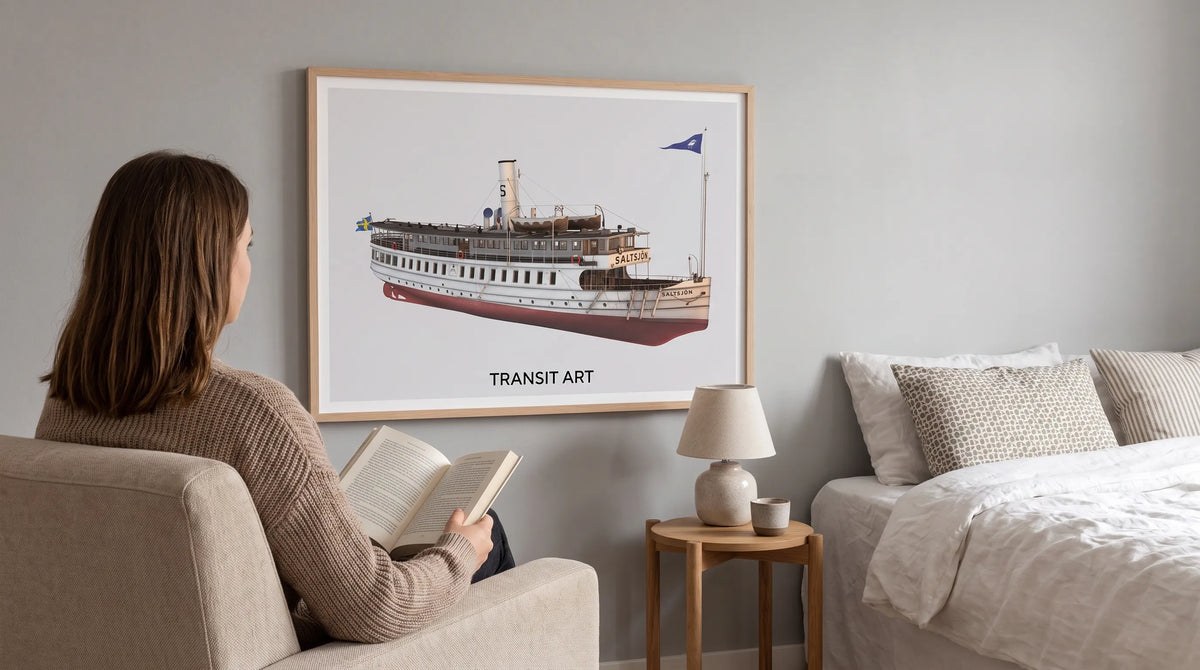
S/S Saltsjön offers a more vessel-focused story. Dating to 1925 and still serving the Swedish archipelago, this Swedish coastal vessel connects present-day journeys with an earlier era of passenger travel. For a boat enthusiast, its appeal lies in that continuity as much as its appearance.
Together, these subjects give a guest room a specific sense of place without requiring the visitor to share a specialist interest in ships.
Decorating with travel art for a quieter guest room
The aim is not to recreate a cabin or decorate every surface with nautical references. Instead, let the artwork introduce the destination while the furniture, lighting and textiles make the room comfortable.
Borrow a little color, not an entire theme
Start with the bedding and wall color you already have. Warm white, oatmeal, pale gray and natural wood provide a flexible backdrop for illustrated prints. Against those quieter surfaces, a more colorful poster can become the room’s main accent rather than competing with several patterned accessories.
For a Swedish-inspired pairing, a small touch of blue or yellow can echo the flag in the canal poster. One cushion or a bedside ceramic is enough. You do not need matching curtains, striped bedding and decorative anchors to make the connection clear.
If you prefer coastal references without familiar seaside motifs, our guide to bringing coastal character indoors with boat artwork explores that distinction in more detail.
Choose the view guests will actually enjoy
Look at the room from the doorway, then sit on the bed. These two viewpoints often reveal a better position than simply choosing the largest empty wall.
Above a dresser, a print can create a welcoming arrival view. Opposite the bed, it gives guests something considered to look at while resting. Beside a reading chair, a smaller work can make an otherwise overlooked corner feel intentional.
As a starting point, try an artwork grouping around half to two-thirds the width of the furniture beneath it, then adjust with paper templates. This is a visual guideline, not a requirement. Leave switches, outlets and luggage space accessible, and use hardware appropriate to the wall and frame weight.
Keep the framing consistent
Matching frames can connect two subjects without making them look identical. Pale wood is an option alongside light furniture; a slim dark frame can relate to an existing lamp or bed frame. Choose the finish that belongs in the room rather than assuming every waterside image needs a rustic frame.
A mat can give detailed travel art more breathing room, especially when the surrounding furniture is compact. Match the frame and mat opening to the print dimensions you select.
Recommended Poster Pairings
These two Transit Art posters work together because they share a Swedish waterway connection while offering different points of attention. One centers on a historic vessel; the other includes a person and the experience of being beside the canal.
S/S Saltsjön: a vessel with a continuing story
The S/S Saltsjön print suits guests and hosts who appreciate maritime history, transport illustration and carefully observed detail. The subject’s long working life gives it more substance than a purely decorative boat motif: it depicts a vessel with a connection to Swedish archipelago travel that continues today.
Transit Art offers the detailed illustration as a Giclée print on 200 gsm / 80 lb museum-quality matte, uncoated paper, with three sizes available. Those options let you consider either a more prominent placement above a dresser or a smaller position within a reading corner, depending on the dimensions of your room.
Let the illustration carry the transport interest. A simple frame and an uncluttered surface beneath it will give guests room to notice the vessel’s details without surrounding it with competing maritime objects.
Göta Canal Vintage Travel Poster: a more human perspective
The Göta Canal Vintage Travel Poster brings a different kind of invitation. Its scene features a fashionable woman seated on a dock, with a Swedish flag in the background. Rather than focusing only on transportation, it presents the waterway as somewhere to pause and spend time.
That human presence makes it a useful companion to the vessel illustration. The pairing moves between the means of travel and the experience of being there, giving the wall a shared subject without repeating the same composition.
This is where travel art can feel personal rather than merely decorative. A host might choose the pair because of a Swedish holiday, an interest in passenger vessels or an affection for slower journeys. Guests can enjoy the imagery without needing to know that backstory.
Place the two works above a wide dresser if their selected sizes fit comfortably. Alternatively, give the canal scene the main arrival view and position S/S Saltsjön near a chair, where its detail can be appreciated at closer range.

Make the pairing work with the room you have
Before ordering, measure the usable wall rather than the whole wall. A door swing, tall headboard or reading light can reduce the space available for a print. Make paper templates that include the proposed frames, then check the arrangement from both the doorway and the bed.
| Guest-room situation | Arrangement to try | Detail to check |
|---|---|---|
| A wide, low dresser | Display the two prints as a pair | Leave clear space above objects on the dresser |
| A compact bedroom | Choose one main print and place its companion elsewhere | Avoid crowding the bed with multiple focal points |
| A room with a reading chair | Position the vessel illustration nearby | Check visibility from the seated position |
| A room with strong daylight | Test the proposed wall at different times | Avoid persistent glare and direct sunlight on paper prints |
Lighting deserves the same attention as placement. Turn on the bedside lamps after dark and look for reflections across the artwork. Adjust the location if necessary rather than adding a bright picture light that competes with the room’s quieter evening lighting.
Travel art works best here as part of the welcome, not as another object guests must work around. Keep the bedside table useful, leave a surface free for belongings and resist adding a third or fourth print simply because space remains.
Give the room personality without overfilling it
A guest room can reflect your interests while still making visitors feel at home. The difference lies in editing. Two connected prints usually tell a clearer story than a mixture of unrelated destinations, transport types and decorative signs.
If the room also serves as a home office, keep the main arrangement separate from the desk’s busiest area. A pair above a dresser can remain visually settled even when the workspace is in use. Closed storage for office supplies will do more for that calm impression than another decorative accessory.
For hosts building a collection gradually, our guide to curating artwork around transit design offers a broader way to connect subjects without making every print match. In a guest room, that connection only needs to be clear enough to make the space feel considered.
Frequently Asked Questions
Is travel art suitable for a small guest room? Yes. One well-proportioned print can establish the room’s character without using floor space. Try paper templates before choosing a size, and favor one clear focal point over several small arrangements competing for attention.
Do the two posters need matching frames? Matching frames are an easy way to create continuity, but they are not essential. Similar frame depth, mat treatment or finish can also connect the works. Test the combination against your existing furniture before deciding.
Should guest-room artwork hang above the bed? It can, but that is not automatically the best position. A dresser wall or the wall opposite the bed may offer a better viewing angle. If hanging anything overhead, use suitable fixings and seek professional installation advice when needed.
How can I keep a Swedish waterway pairing from looking overly nautical? Let the posters provide the reference. Combine them with ordinary bedroom materials such as cotton, wood and simple ceramics rather than adding ropes, anchors or ship-themed accessories throughout the room.
A small escape with a sense of place
The most inviting guest rooms balance personality with space for someone else to settle in. Travel art can provide that personality through a particular route, a historic vessel or a scene that suggests an unhurried afternoon.
S/S Saltsjön and the Göta Canal poster offer two complementary ways into the same Swedish waterway story. Choose their sizes around the room’s actual sightlines, keep the framing coherent and leave the surrounding surfaces useful. The result is a guest room with something to discover, without too much to take in.