Article: How to Check the Quality of Canvas Prints Online
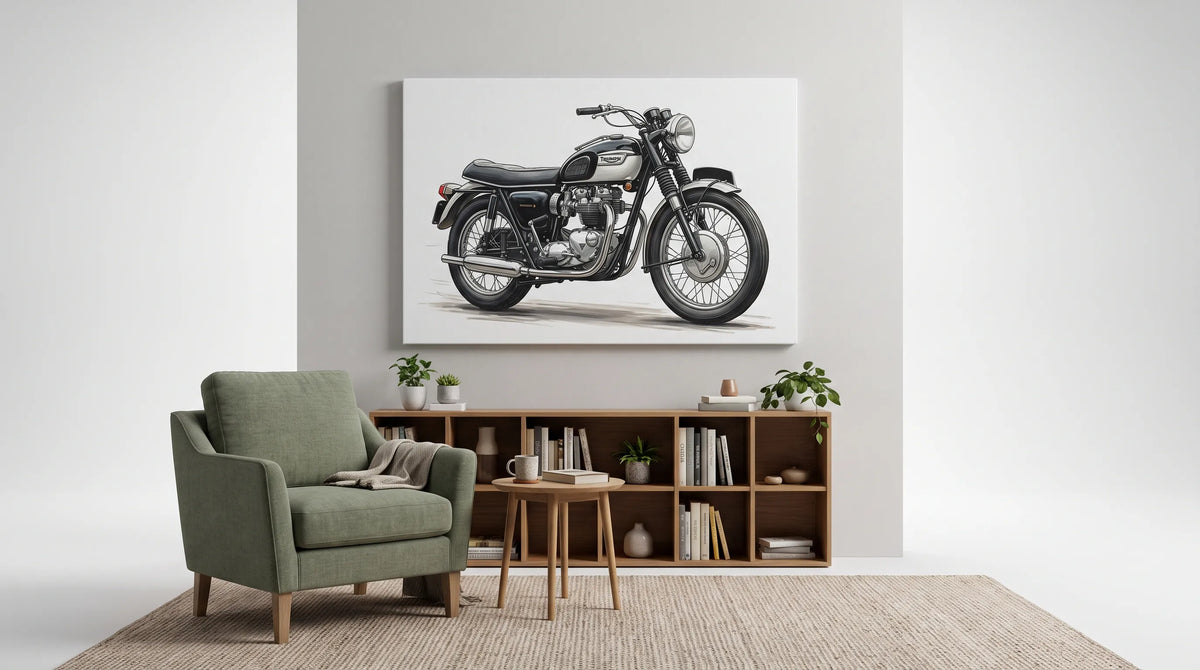
How to Check the Quality of Canvas Prints Online
How to Check the Quality of Canvas Prints Online
Checking canvas prints quality online takes more than looking at a convincing room mockup. A beautiful automotive illustration can still disappoint if the reproduction loses detail, the canvas hangs unevenly or the wrapped edges crop an important part of the vehicle.
The most useful evidence comes from close-up photographs, clear material specifications and an explanation of how the finished piece is constructed. This guide helps you separate those details from marketing language, choose a suitable size and find transport-inspired artwork that feels right in your home.
Confirm What You Are Actually Buying
Before comparing quality, establish whether the listing is for a paper poster, an unstretched canvas, a stretched canvas or a framed canvas. Those formats need different finishing and hanging arrangements.
A stretched canvas has fabric secured around a supporting frame, usually called stretcher bars. A decorative outer frame is a separate component, so “framed” and “stretched” should not be treated as interchangeable.
Check that the selected size and format match the photographs you are viewing. A listing may show several presentation options without including every option in your selection.
Transit Art’s Auto haven canvas, depicting an automotive scrapyard scene by Sune Envall, provides a canvas-specific starting point. For any artwork, confirm the selected dimensions and presentation before comparing it with another product.
How to Check Canvas Prints Quality in Product Photos
Room photographs help you imagine the artwork at home, but they reveal little about the physical print. Look for photographs showing the actual surface, corners, sides and reverse.
Look for meaningful close-ups
A useful detail photograph should let you inspect both the printed image and the canvas weave. Vehicle artwork gives you several recognizable features to examine: wheel spokes, lettering, chrome trim and the edges of body panels.
Those features should remain readable where the original artwork depicts them clearly. Watch for blocky edges, unintended blur or halos around high-contrast outlines.
However, softness is not automatically a defect. A painterly image may contain loose brushwork, atmospheric dust or deliberately softened backgrounds. The question is whether the print preserves the artist’s decisions rather than introducing new flaws.
Separate the artwork from the mockup
A digital room mockup can demonstrate placement, but it cannot prove that the canvas is tightly stretched or accurately printed. Even the apparent size can be misleading if the furniture dimensions are unknown.
When evaluating canvas prints quality, prioritize photographs of the finished object over lifestyle images alone. If those photographs are missing, ask for a surface detail and a view of one wrapped corner.
Also inspect the preview for cropping. A composition that works beautifully on paper may need a different edge treatment when reproduced on stretched canvas.
Read Material Claims With a Critical Eye
Terms such as “premium,” “gallery quality” and “museum quality” do not tell you enough on their own. Look for concrete information about the substrate, printing process and construction.
| Listing detail | What it helps you assess | What it does not establish alone |
|---|---|---|
| Canvas fiber composition | Whether the substrate is cotton, polyester or a blend | Overall reproduction quality |
| Ink information | The printing system and any stated durability testing | A guaranteed lifespan in every room |
| Protective coating | Whether a surface treatment is specified | Resistance to all moisture or scratches |
| Stretcher-bar details | Frame material, depth and construction | Whether the individual canvas is evenly tensioned |
| Edge photographs | Corner finishing and wrap treatment | The sharpness of the entire image |
Cotton and polyester canvases can both produce attractive results. Fiber composition should be considered alongside coating compatibility, print detail and stretching, not used as a simple good-versus-bad ranking.
For canvas prints quality, specific construction details are more informative than a long string of flattering adjectives.
Transit Art identifies FSC-certified paper among its print materials. That is relevant to paper sourcing, but a paper specification should not be assumed to describe a canvas product. Read the details for the exact format you intend to order.
Ask what supports longevity claims
If a seller advertises fade resistance, look for an explanation of the ink, substrate and testing behind that claim. A stated lifespan without display conditions is difficult to interpret.
Pigment inks are commonly used for fine-art reproduction, but ink type alone does not establish durability. The complete printing system and the environment both matter. Direct sunlight, damp conditions and inappropriate cleaning can affect a finished print.
Check Sharpness at the Size You Want
A small website preview cannot show how an image will look across a large canvas. Ask whether the artwork is prepared for your selected dimensions and whether a close-up of that size is available.
Pixel dimensions can provide context when the seller supplies them. For example, an image measuring 3,600 pixels across would provide 150 pixels per inch when printed 24 inches wide. That calculation describes image resolution, not the printer’s advertised dots per inch.
There is no single resolution threshold that guarantees an attractive result. Viewing distance, canvas texture, subject detail and the original artwork all influence the outcome. Small lettering requires more scrutiny than broad painterly shapes viewed across a room.
A practical canvas prints quality assessment asks whether the important details survive enlargement, not simply whether a listing displays a large technical number.
Allow for screen-to-print differences
A screen emits light; a canvas reflects it. Bright highlights and saturated colors may therefore look different in person. Screen brightness, display settings and room lighting add further variation.
Use product photographs to judge relationships between colors rather than expecting an exact match to your phone. If matching an existing interior is essential, ask whether a physical sample is available rather than assuming one is offered.

Use the Subject to Judge the Reproduction
Knowing what you are looking at makes visual inspection easier. Automotive art contains mechanical forms, recognizable silhouettes and environmental details that can reveal whether a reproduction retains the character of the original.
Parisian streets and Citroën heritage
Hillclimb in Paris depicts a Citroën food-delivery vehicle struggling uphill in Montmartre. The appeal lies in the everyday scene as much as the vehicle: a working machine navigating a neighborhood associated with Parisian artistic life.
The product’s connection to the Citroën 2CV adds another layer. Introduced in 1948, the 2CV became known for practical simplicity, distinctive rounded bodywork and its place in everyday French motoring.
For admirers of French cars and travel-inspired interiors, that recognizable character matters. Inspect whether the reproduction preserves the vehicle’s outline and its relationship to the street, without confusing intentionally loose illustration with printing blur.
Motorcycle character and barn atmosphere
Classic Harley in a dust filled barn places motorcycle heritage in a weathered setting. Harley-Davidson, founded in Milwaukee in 1903, has a long association with American motorcycling and custom-bike culture.
The supplied description does not identify a particular model, so model-specific engine or performance claims would be inappropriate. Its visual appeal instead comes from the contrast between the motorcycle and the surrounding barn atmosphere.
Here, canvas prints quality depends partly on preserving differences within darker areas. Inspect whether mechanical forms remain distinguishable where intended, rather than merging into a flat dark patch. This kind of artwork can appeal to riders, collectors and people who enjoy industrial interiors.
Interior Design: Choose Scale Before Maximum Size
A well-made canvas can still look wrong if it overwhelms a wall or disappears above substantial furniture. Measure the available area, then mark the proposed dimensions with removable paper templates.
Above a sofa, desk or sideboard, consider the artwork in relation to the furniture rather than the wall alone. Leave enough surrounding space for the composition to feel deliberate. Multiple smaller works may suit a narrow room better than one oversized piece.
Canvas offers a textured, dimensional presentation, while a paper print allows different framing and matting choices. Transit Art’s guide to creating a gallery-quality look with paper prints explains the alternative if you prefer a more structured framed arrangement.
Viewing distance also changes how you judge canvas prints quality. A piece beside a reading chair invites close inspection; artwork across a living room needs a composition that reads clearly from farther away.
Avoid direct sunlight and damp locations. For everyday care, follow the seller’s instructions rather than assuming the surface can be wiped with household cleaners.
Recommended Poster Pairings
Pair transport artworks through their shared story, not simply because both feature vehicles. Confirm each product’s available format separately; an artwork shown in the store should not automatically be assumed to come as a canvas.
Hillclimb in Paris: everyday vintage transport
Use Hillclimb in Paris as the starting point for a travel-oriented arrangement in a dining nook, hallway or home office. Its street setting brings a sense of place, making it suitable for someone whose enthusiasm extends beyond cars to architecture and city life.
Classic Harley in a dust filled barn: mechanical heritage
Classic Harley in a dust filled barn offers a complementary view of vintage transport through workshop atmosphere rather than urban activity. It can suit a study or a reading area with wood and metal furnishings.
The two artworks can form a pair around the theme of working machines and lived-in places. Compare their actual previews before ordering, particularly their overall brightness and dominant colors. Matching outer dimensions or consistent framing can connect the pair without requiring identical subjects.
If one image feels much darker than the other, placing them on separate walls within the same room may work better than forcing a symmetrical arrangement.
Frequently Asked Questions
Can I judge quality from a room mockup alone? No. A mockup helps with styling, but close-ups of the surface, edges and corners provide better evidence of the physical product.
Does thicker canvas always mean better quality? No. Canvas weight is only one factor. Image reproduction, surface preparation, construction and even tension also affect the result.
What should I ask if the listing lacks detail? Ask for the substrate composition, ink information, edge treatment, selected-size dimensions and photographs of the finished canvas. Check the seller’s damage-reporting and return terms too.
What is the quickest canvas prints quality check before ordering? Confirm the format, inspect a real close-up, examine the wrapped edges and verify that the composition is suitable for your chosen size.
Choose Artwork With Evidence Behind It
Start with a subject you genuinely enjoy, then verify how it will be reproduced and presented. A Parisian delivery scene or a classic motorcycle can bring personal meaning to a room, but clear specifications and convincing product photographs should support the choice. Compare the details before committing to the largest size.