Understanding Art Print Sizes Before You Choose a Frame
Choosing art print sizes is easier once you separate the dimensions of the paper from the dimensions of the finished frame. A 12 × 16-inch print might fit directly into a matching frame, but adding a mat means choosing a larger frame and allowing more wall space.
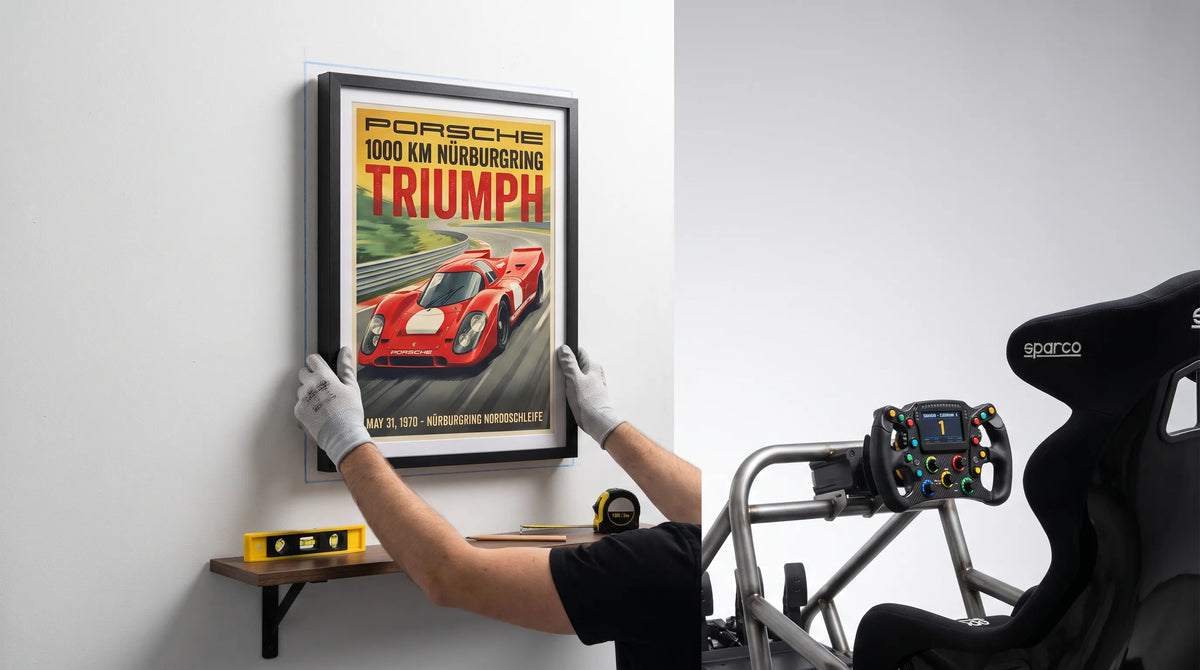
For transport-inspired artwork, those decisions affect more than fit. The right proportions preserve a car’s silhouette, keep railway lettering readable and give the composition enough room to breathe. Here’s how to choose the print first, then find a frame that suits it.
Start with the four measurements that matter
A product listing, frame label and mat description can each refer to something different. Before ordering, identify these four measurements:
- Paper size: The outside dimensions of the sheet you receive, including any unprinted border.
- Printed image size: The area occupied by the artwork, which may be smaller than the paper.
- Mat opening: The window through which you see the print. It usually overlaps the paper slightly to hold its edges behind the mat.
- Outside frame size: The complete framed object, including the width of the frame molding.
A frame advertised as 16 × 20 inches usually describes the size of the material it accommodates, not its outside dimensions. Check the manufacturer’s specifications rather than assuming that measurement is its footprint on the wall.
Also establish whether a white border is printed into the artwork. That border remains part of the sheet; it is not a separate mat.
Common art print sizes in inches and centimeters
The following dimensions are common reference points, not a statement that every design is available in every size. Check the options on the individual product listing before choosing a frame.
| Print dimensions in inches | Approximate dimensions in centimeters | Possible placement |
|---|---|---|
| 5 × 7 | 12.7 × 17.8 | Shelf or compact grouping |
| 8 × 10 | 20.3 × 25.4 | Desk area or small wall |
| 11 × 14 | 27.9 × 35.6 | Reading corner or gallery wall |
| 12 × 16 | 30.5 × 40.6 | Home office or paired display |
| 16 × 20 | 40.6 × 50.8 | Medium wall or larger grouping |
| 18 × 24 | 45.7 × 61.0 | Standalone accent |
| 24 × 36 | 61.0 × 91.4 | Larger focal point |
Small, medium and large are informal descriptions. One shop’s large print may be another shop’s medium, so compare actual measurements rather than category names.
How A-series paper compares
ISO A-series formats use metric dimensions and a consistent width-to-height relationship. They do not directly match common US frame sizes.
| Paper format | Dimensions in millimeters | Approximate dimensions in inches |
|---|---|---|
| A5 | 148 × 210 | 5.83 × 8.27 |
| A4 | 210 × 297 | 8.27 × 11.69 |
| A3 | 297 × 420 | 11.69 × 16.54 |
| A2 | 420 × 594 | 16.54 × 23.39 |
An A4 print is not interchangeable with an 8 × 12-inch print, even though they look similar at a glance. Likewise, a 30 × 40-centimeter sheet is smaller than a 12 × 16-inch sheet. Rounding is useful for comparison, but not for confirming frame compatibility.
Match the aspect ratio before changing the size
When comparing art print sizes, check their aspect ratios as well as their dimensions. The aspect ratio describes the relationship between width and height.
An 8 × 10-inch print and a 16 × 20-inch print both have a 4:5 ratio. The same composition can scale between them without changing its proportions. A 12 × 16-inch print has a 3:4 ratio, so it is a different shape.
Other common families include 2:3 for 12 × 18 and 24 × 36 inches, and 3:4 for 9 × 12 and 18 × 24 inches. A-series paper follows an approximately 1:1.414 relationship.
Moving artwork between different ratios requires cropping, adding borders or altering the layout. Stretching the image is not a good substitute: wheels can become oval and vehicle proportions can look wrong.
For automotive and railway prints, inspect the preview for clipped bumpers, missing lettering or cramped edges. Do not assume that a design’s largest option shows exactly the same composition as its smallest.
Resolution is separate from physical size
Pixel dimensions matter when you are preparing a digital file for printing. At 300 pixels per inch, a 12 × 16-inch image requires 3,600 × 4,800 pixels. Other resolutions can be appropriate depending on the artwork, printing process and viewing distance.
For a finished poster, you should not need to calculate this yourself. Look for clear product information and detailed previews rather than judging quality from a small thumbnail alone.
Choose the frame and mat as a complete package
Before settling on larger art print sizes, work out how much the mat and frame will add. A modest sheet can become a substantial wall piece once both are included.
For example, a 12 × 16-inch sheet inside a nominal 16 × 20-inch frame leaves a nominal two-inch allowance on each side. The actual visible border depends on the mat opening, its overlap and the frame’s construction. The outside frame measurement will be larger again.
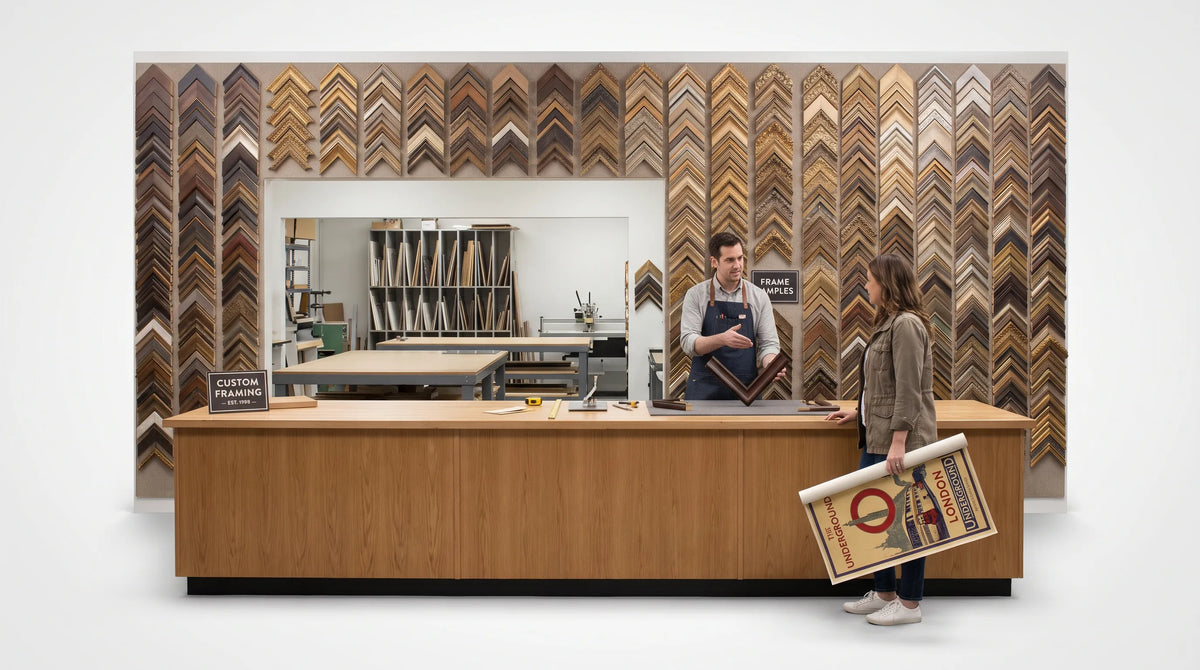
A mat opening should normally be slightly smaller than the paper, but it must not hide an important signature, caption or design detail. If the image reaches the sheet’s edges, discuss the opening with a framer before ordering a ready-cut mat.
Our guide to choosing mat borders for paper posters explains how border width and color affect the finished presentation. For paper artwork, also ask about conservation-quality mounting materials and avoid permanently attaching the print to its backing.

Interior design: measure the wall, not just the print
Start with the usable wall area above or beside your furniture. Account for switches, lamps, door movement and nearby shelving. Then mark out the outside frame dimensions with paper templates or wall-safe tape tested in an inconspicuous spot.
Above a sofa or console, a framed arrangement spanning roughly two-thirds to three-quarters of the furniture’s width can be a useful starting point. Treat it as a visual test, not a requirement. Nearby architecture and the artwork’s visual weight may suggest a different balance.
For a gallery wall, include the gaps in your calculation. Two frames that are each 18 inches wide with a three-inch gap need 39 inches overall. Three need 60 inches with the same spacing.
Step back to the room’s normal viewing position before deciding. Detailed locomotive drawings may invite close viewing, while a bold car silhouette can remain legible farther away. The guidance on choosing poster prints that look good across a room can help you assess that difference.
Recommended Poster Pairings
Coordinated art print sizes can connect different transport subjects without making the room feel like a themed showroom. Matching outside frame dimensions is often more effective than insisting that every sheet be identical.
Transit Art offers posters across car, motorcycle, train and other transport themes, with multiple sizes available. Its paper prints use FSC-certified paper, but check each selected design for its specific dimensions and finish before planning the arrangement.
A car poster with a motorcycle poster
Explore the shop’s car poster options alongside its motorcycle poster options for a pairing built around road-going design.
Enthusiasts often appreciate the engineering details and recognizable shapes of both subjects. Choose two compositions with a similar background tone or comparable visual simplicity. Matching frames can create a cohesive pair above a home-office credenza, even when the vehicles come from different periods.
A train poster with a plane poster
A train poster and a complementary plane poster can connect railway and aviation interests through the broader story of travel.
Transport imagery has a long association with travel advertising, where vehicles and destinations made journeys feel desirable. That connection gives this pairing a natural place in an entryway or study. Select designs with compatible colors and let one lead if their compositions have different levels of detail.
Frequently asked questions
What are the most common art print sizes? Frequently encountered US formats include 8 × 10, 11 × 14, 12 × 16, 16 × 20, 18 × 24 and 24 × 36 inches. A4, A3 and A2 are common metric alternatives, but they require appropriately sized frames.
How big is an A5 art print? A5 measures 148 × 210 millimeters, or approximately 5.83 × 8.27 inches. It can suit a shelf or small grouping, although a mat and frame will increase its overall footprint.
How big is a 12 × 16-inch print? It measures approximately 30.5 × 40.6 centimeters before framing. In portrait orientation, it is 12 inches wide and 16 inches tall. Confirm whether those measurements describe the sheet or the printed image.
Can I put a smaller print in a larger frame? Yes, using a correctly sized mat or another suitable mounting approach. Check the frame’s fitting dimensions, the mat’s outside dimensions and its opening. A larger frame alone will not securely support a smaller sheet.
Choose the artwork first, then confirm the fit
Start with a subject you enjoy seeing, whether that is a familiar vehicle shape or a reminder of a memorable journey. Then confirm the paper dimensions, composition, mat opening and outside frame measurements in that order.
A few minutes with a tape measure and a paper template can prevent an awkward crop or an undersized display. The aim is a finished piece that gives both the artwork and your room the space they need.