Artikel: Choosing Art on Canvas for a Model Car Display Room
Choosing Art on Canvas for a Model Car Display Room
Choosing Art on Canvas for a Model Car Display Room
The right art canvas gives a model car collection context without competing with the cars themselves. A racing scene can connect miniature endurance racers to their full-size history, while a workshop illustration can make a cabinet of road cars feel like part of a thoughtfully arranged collection.
The challenge is that model rooms already contain plenty of visual detail: liveries, wheels, badges, display bases and cabinet edges. Your wall art needs to organize that detail rather than add another layer of clutter. Start with the collection’s story, then consider format, size and placement.
Let the Models Set the Direction
Before choosing artwork, identify what holds your collection together. It might be a manufacturer, a racing series, a decade or simply your affection for beautifully engineered machines.
A cabinet devoted to 1960s endurance racing benefits from artwork with a clear connection to that era. A mixed collection of road cars may suit a garage scene better than a single competition car. Neither approach requires every model to match the picture exactly. The connection just needs to feel intentional.
Also consider how you enjoy the room. If you photograph models, preserve a quiet background near your photography surface. If you spend time examining individual cars, position detailed artwork where you can approach it without leaning across a cabinet. A room used mainly for viewing the collection from a chair needs a different arrangement from one used for building kits.
Choose an Art Canvas Format That Suits Close Viewing
For this room, you are choosing a finished canvas print, not a blank painting canvas. The distinction matters when browsing: descriptions of priming, paint absorption and painting media usually concern artists’ supplies rather than ready-to-display wall decor.
Canvas has a visible surface texture that can complement painterly automotive imagery. Fine technical drawings and tiny lettering deserve closer inspection because texture may make small details less distinct.
| Format | Useful qualities in a model room | What to check |
|---|---|---|
| Stretched canvas print | Adds depth without requiring a glazed frame | Overall depth, edge treatment and hanging requirements |
| Framed paper print | Offers a defined border around detailed artwork | Frame dimensions and reflections from glazing |
| Rolled canvas print | Allows separate decisions about stretching and framing | Whether professional stretching is needed before display |
These are general format options, not a statement that every Transit Art design comes in each version. Check the individual product page for available materials and dimensions.
Look Beyond the Front Surface
A canvas projects farther from the wall than an unframed paper print. Check that projection beside cabinet doors, wall-mounted shelves and narrow walkways. If the artwork has wrapped edges, consider whether you prefer the image continuing around the sides or a separate frame defining its boundary.
Give the Collection a Motorsport Story
An art canvas becomes more meaningful when its subject explains something about the models below it. For endurance-racing collectors, few subjects offer as much context as the Ford and Ferrari rivalry.
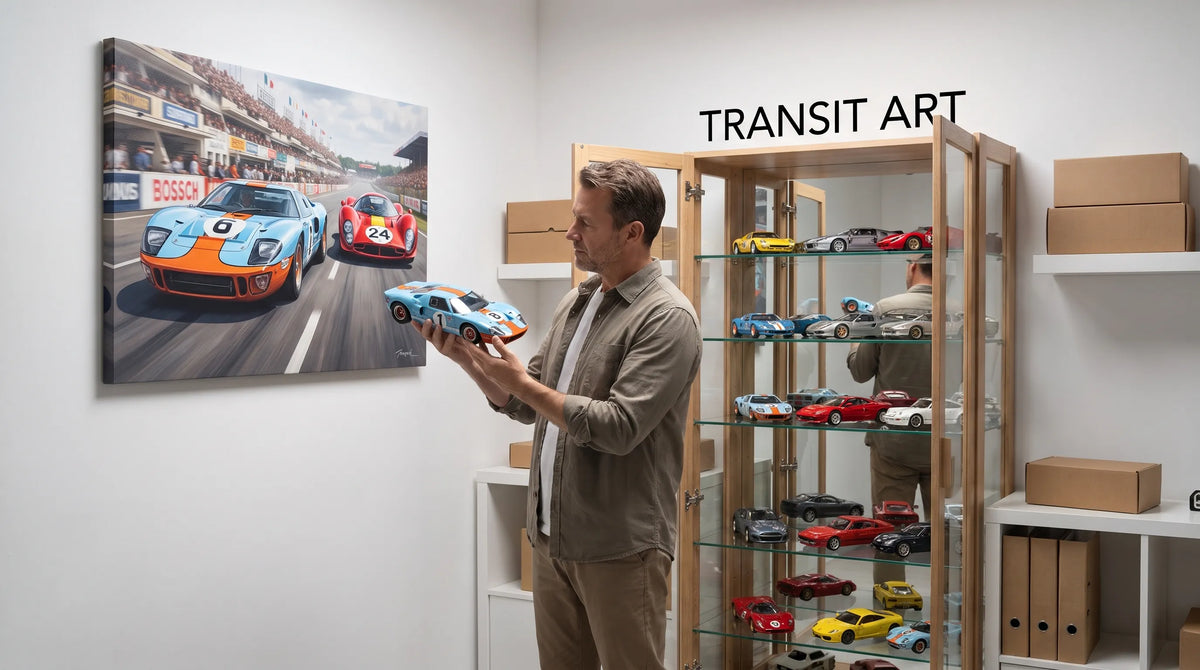
Transit Art’s LeMans dawn duel depicts a Ford GT40 and Ferrari P4 near the Dunlop curve at Le Mans in 1967. The scene connects two celebrated racing shapes with a period when endurance competition carried considerable engineering and corporate ambition.
Ford’s effort followed its unsuccessful attempt to buy Ferrari in 1963. The GT40 program eventually delivered Ford’s first overall Le Mans victory in 1966. Ferrari’s P4, introduced for the 1967 season, remains admired for its flowing bodywork and association with the marque’s sports-prototype racing heritage.
One historical distinction is useful when arranging model labels: the overall winner of the 1967 24 Hours of Le Mans was the Ford Mk IV. Keep the identity of each miniature separate from the broader rivalry represented in the artwork.
This subject particularly suits collectors of endurance racers, historic motorsport enthusiasts and anyone drawn to the contrast between purposeful engineering and sculptural bodywork. Place related Ford and Ferrari models nearby, with enough space between them to make the comparison visible.
Size the Artwork Around the Cabinet
Choose an art canvas in relation to the display furniture, not simply the largest empty area of wall. The cabinet and picture should read as a group, with neither appearing accidentally undersized.
As a starting point, test artwork approximately two-thirds to three-quarters of the cabinet’s width. Above a 48-inch-wide cabinet, that suggests a composition around 32 to 36 inches wide. These are layout examples, not advertised product sizes or fixed decorating rules.
Mark the proposed dimensions with painter’s tape before ordering. Include any outer frame in your measurements, then check the outline from the doorway and your usual viewing position. A picture that looks balanced while standing beside the cabinet may disappear behind the collection when you sit down.
Horizontal artwork often works above a long, low display. A vertical piece can be more effective beside a tall cabinet, where it has its own uninterrupted wall space. Leave sufficient clearance for doors, lighting and access to the top shelf.
Do not default to a standard hanging height if the cabinet makes it impractical. The important relationship is between the visible artwork, the furniture beneath it and the person viewing both.
Make Color and Lighting Work Together
Treat the art canvas and the cabinet as one lighting arrangement. Brightly lit models beneath a dim picture can make the artwork disappear; a strong spotlight above the picture can create distracting reflections in cabinet glass.
Begin with soft, even room lighting. If you add an adjustable picture light or spotlight, test its angle from both standing and seated positions. Low-heat LED fixtures are a practical choice, but keep fittings and cables clear of artwork and display cases. Avoid direct sunlight, which can contribute to fading and unwanted heat.
For color, choose one restrained connection between the artwork and the collection. It might be a muted body color, a warm neutral or the dark tone used in display bases. There is no need to repeat every racing livery around the room.
A pale wall can separate darker models from their surroundings. A deeper wall color can make a light-toned print stand out, provided the cabinet remains adequately lit. If the collection is especially colorful, keep nearby frames and accessories quiet. The cars already supply the detail.

Recommended Poster Pairings
Build pairings around a shared story rather than collecting unrelated automotive pictures. The combinations below use Transit Art designs, including two products explicitly offered as canvas prints. Check the available format of each artwork before planning a matching set.
LeMans Dawn Duel and Mercedes 300 SL at Workshop
Pair the Le Mans scene with Mercedes 300 SL at Workshop, canvas to connect competition with the preparation and engineering behind it.
The road-going 300 SL coupe arrived in 1954, drawing on Mercedes-Benz’s earlier racing program. Its gullwing doors and fuel-injected straight-six helped make it one of the most recognizable sports cars of its period. Collectors who appreciate mechanical history as much as race results will understand the connection.
Use the racing scene above the main display and the workshop artwork near a model-building desk or secondary cabinet. Keeping some distance between them gives each scene room to tell its story. Consistent outer framing, where appropriate, can connect the pair without requiring identical imagery.
Mercedes 300 SL at Workshop and Auto Haven
For a room centered on road cars and restoration, pair the Mercedes artwork with Auto haven, canvas, which depicts an automotive scrapyard scene.
This art canvas pairing shifts attention from showroom perfection to the places where cars are maintained, stored and rediscovered. The workshop suggests care and mechanical attention; the scrapyard introduces the appeal of overlooked vehicles and possible restoration projects.
The combination suits collectors of classic saloons, weathered miniatures and everyday vehicles with personal significance. Place the works beside a cabinet containing varied road cars, or on a separate wall near a workbench. Let their automotive settings provide the connection, then use matching spacing or framing to give the arrangement consistency.
Leave Room for the Collection to Change
A model collection rarely stays fixed. New arrivals can change its emphasis, and a growing cabinet may eventually need a different shelf layout.
Avoid filling every gap with artwork, signs and memorabilia. A clear area around the main picture makes future changes easier and helps the existing display feel deliberate. One substantial work often provides a stronger backdrop than several small pieces squeezed between shelves.
Keep a little separation between wall art and handling areas, too. You should be able to remove a model, open a display case or clean a shelf without brushing against a canvas. Mount artwork independently using hardware suitable for its weight and your wall construction, and secure display furniture as its manufacturer recommends.
Frequently Asked Questions
Should the artwork match the exact cars in my collection? Not necessarily. A shared era, manufacturer or racing discipline can create a convincing connection. Exact matches are especially effective when you want to highlight a favorite model or compare versions of the same car.
Is an art canvas better than a framed poster for this room? Neither is universally better. Canvas adds surface texture and depth, while a framed paper print provides a defined border and may suit fine linework. Consider the image itself, nearby cabinet reflections and the available wall space.
Can I hang artwork directly above a glass display cabinet? Yes, if it is securely mounted to the wall with appropriate hardware. Leave room for doors and maintenance, and do not rely on the cabinet to support the artwork.
Should all the pictures use the same frame? Matching frames help unify different subjects, but they are not essential. Consistent spacing, related proportions and a clear theme can also make a grouping feel cohesive.
Build a Display With a Clear Point of View
The most satisfying model rooms make the collector’s interests easy to understand. Choose one artwork that establishes the story, size it around the cabinet and add a companion only when it contributes something distinct.
For a broader decorating perspective, Transit Art’s guide to how premium canvas prints elevate automotive interiors explores how automotive imagery works within a room. In a model display space, keep the final test simple: the artwork should make you enjoy looking at the collection even more.