
Artikel: How to Choose Art for a Home With Low Ceilings
How to Choose Art for a Home With Low Ceilings
How to Choose Art for a Home With Low Ceilings
Bringing art home to a room with low ceilings is less about finding a picture that “adds height” and more about getting the proportions right. A frame squeezed between a sofa and the ceiling can make the wall feel crowded. A well-sized print, placed in relation to the furniture, gives the room a focal point without emphasizing its limited height.
You do not need to restrict yourself to tiny pictures or pale artwork. Start with the available wall space, then consider the image’s visual weight, its frame and how you will see it from a seated position.
Start with the room’s actual proportions
A low ceiling is only one part of the room. A deep sofa, tall headboard, exposed beam or pendant light may have more influence on where a picture belongs than the ceiling height alone.
Look at the wall from the doorway and from your usual seat. Identify the area that feels comfortably available for artwork, rather than treating the entire floor-to-ceiling surface as usable display space.
Keep the artwork connected to the furniture beneath it. Hanging a picture unusually high to suggest a taller room often leaves an awkward gap above the sofa while pushing the frame toward the ceiling.
Also consider nearby objects. A tall bookcase, floor lamp and large framed print can compete for the same limited vertical space. Removing one of those competing elements may improve the composition more than choosing a smaller picture.
Measure before you bring art home
Measure the ceiling height, the top of the furniture and the outside dimensions of the proposed frame. The printed image size alone will not tell you whether the finished piece fits, especially if you plan to add a mat.
A useful calculation is:
Frame-top height = furniture height + gap above furniture + outer frame height.
For example, imagine a room with a 90-inch ceiling and a sofa back 32 inches above the floor. Allowing an illustrative 8-inch gap gives these two options:
| Measurement | Smaller framed piece | Taller framed piece |
|---|---|---|
| Sofa-back height | 32 inches | 32 inches |
| Gap above sofa | 8 inches | 8 inches |
| Outer frame height | 30 inches | 42 inches |
| Top of frame above floor | 70 inches | 82 inches |
| Space remaining below ceiling | 20 inches | 8 inches |
Neither option is automatically wrong. The taller frame simply leaves much less open wall above it, which may feel crowded beneath a beam or crown molding.
Check width separately. A very narrow picture can look disconnected above a broad sofa, even when its height is suitable. If this is your main display wall, the guide to hanging living room art prints above a sofa explores that furniture-to-art relationship in more detail.
Choose an image with a clear visual hierarchy
Before you bring art home, look beyond whether its format is portrait or landscape. The arrangement inside the image matters too: a simple composition with a strong focal point may feel calmer than a similarly sized print filled with dense detail.
Vertical artwork is an option, not a rule
A portrait-format print can encourage an upward glance, but it will not change the room’s architecture. If its frame nearly touches the ceiling, the effect may be more cramped than uplifting.
Landscape artwork can work equally well when its width relates to a sofa or sideboard. Look for a format that suits the available rectangle of wall, rather than choosing a tall picture solely because the ceiling is low.
Give bold color enough space
The 1926 Geneva Salon International de l’Automobile Poster offers a useful example of a visually assertive focal point. Its streamlined green allegorical figure leans forward against a fiery red and black background, suggesting the speed and elegance of a hood ornament.
The poster promotes Geneva’s automobile and cycle salon, placing it within the interwar fascination with modern transport. Rather than illustrating a particular production car, it turns movement itself into the subject. That makes it appealing to automotive enthusiasts, collectors of vintage advertising and readers interested in early twentieth-century graphic design.
In a low-ceilinged room, those strong contrasts deserve surrounding space. Let the poster supply the most concentrated color on the wall instead of enclosing it between several equally vivid pictures.
Use framing to keep the composition uncluttered
Once you bring art home, the frame becomes part of its apparent size and visual weight. A broad, dark frame can make a modest print feel substantial. A slimmer profile usually introduces a less prominent boundary between the image and the wall.
For the Geneva poster, a simple black frame could connect with the artwork’s darker areas without introducing another color. A light wood frame is another option if it relates to existing furniture, though the combination should be checked against the actual print and wood finish.
A mat can give a busy image useful separation from its surroundings, but it also increases the finished dimensions. Compare the complete framed footprint before committing to a generous border.
If your room already contains oak, walnut or other noticeable timber finishes, the guide to choosing modern artwork for warm wood interiors can help you assess contrast without matching every surface.

Decide whether one picture is enough
A gallery wall is not automatically too busy for a low ceiling. The challenge is that every frame adds another edge, gap and alignment to manage.
If you choose several pieces, measure their combined outer footprint as though they were one large artwork. Include the spaces between frames. A grouping that looks compact on the floor can become surprisingly tall once its gaps are added.
For the Geneva poster, a single-piece display is a strong starting point. Its vivid background, lettering and sculptural figure already provide several layers of interest. Additional artwork is optional, not necessary to make the wall feel finished.
Before bringing art home as part of a larger collection, decide which piece should lead. In a compact room, keeping one dominant image and quieter surroundings often makes individual works easier to appreciate.
Adapt the placement to how you use the room
Living rooms: judge the view while seated
Assess the proposed position from the sofa or armchair, not only while standing beside the wall. The artwork should feel connected to the seating area rather than suspended above it.
Keep nearby shelves and lamps in the test arrangement. Their height affects how much open wall the picture appears to have.
Bedrooms: include the headboard in your measurements
A tall headboard can leave very little comfortable display space beneath a low ceiling. In that situation, a wall opposite the bed or above a lower dresser may offer a better location.
Use hardware appropriate to the wall and framed weight, particularly for anything installed above a sleeping area.
Home offices: choose a wall that remains visible
A transport poster can give a workspace personality without adding another object to the desk. The Geneva design is especially suited to someone who enjoys motoring history but wants artwork with graphic appeal beyond a literal car portrait.
When you bring art home for an office, check that monitors, shelves and task lights will not obscure its main subject.
Test the layout and protect the print
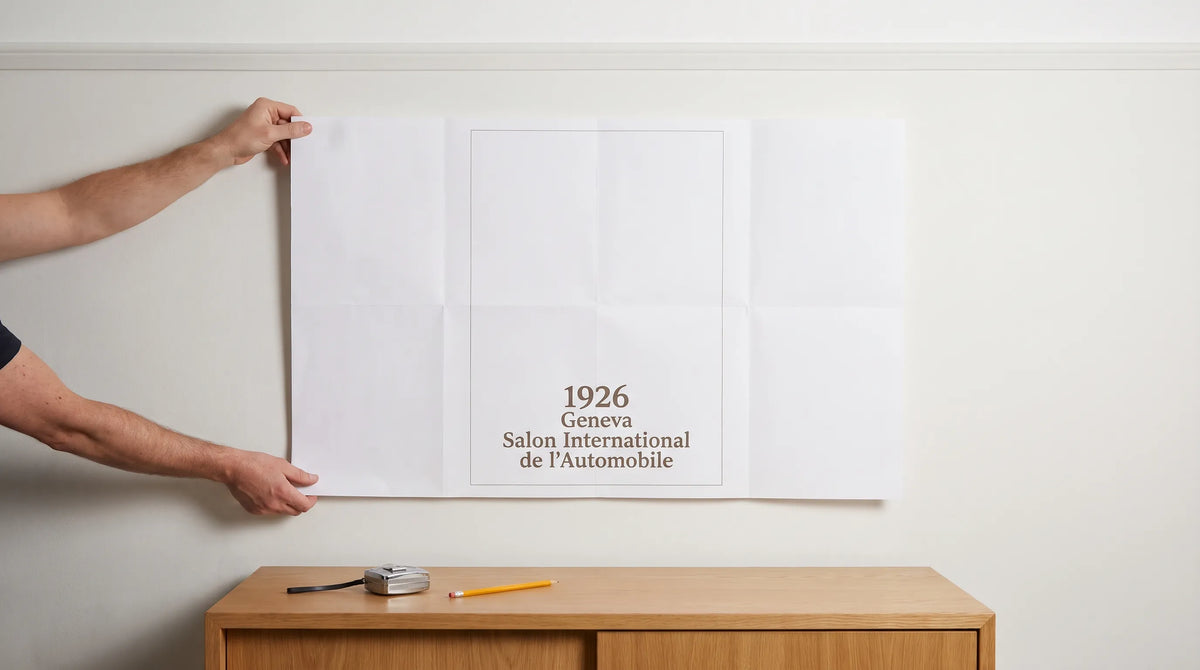
Make a paper template matching the frame’s outside dimensions and temporarily position it with a wall-safe method. View it in daylight and with your evening lighting on. This reveals whether the frame feels too close to the ceiling and whether reflected light interferes with the image.
Renters should check their lease and the limits of any proposed hanging system. Adhesive products are not suitable for every surface or weight; follow the manufacturer’s instructions rather than assuming that a small frame is safe.
Transit Art describes its poster printing as using FSC-certified paper and a gallery-quality finish. FSC certification concerns responsible sourcing, not resistance to sunlight or humidity. Keep paper prints away from persistent damp, direct splashes and strong direct sunlight.
Check the product’s available size options before ordering, then confirm your chosen frame’s outer measurements separately.
Frequently Asked Questions
Should artwork be hung higher in a room with low ceilings? Not simply to suggest height. Position it in relation to the furniture and normal viewing position. Pushing a frame close to the ceiling can emphasize the limited space above it.
Are large prints unsuitable for low ceilings? No. One substantial print can look less cluttered than many small frames. Its complete dimensions must fit comfortably between the furniture and ceiling, with enough surrounding wall to keep the arrangement readable.
Can dark or colorful artwork work in a low room? Yes. A concentrated area of strong color can create a clear focal point. Test the artwork alongside existing furniture and textiles so several bold elements do not compete in the same small area.
What should I check before bringing art home? Confirm the print size, outer frame dimensions, proposed hanging position and wall-fixing requirements. A full-size paper template is a practical way to test all four before installation.
Choose the picture, then give it room
Low ceilings do not require uninteresting walls. Choose artwork you enjoy, calculate its finished footprint and leave enough space for the composition to stand on its own. For someone drawn to automotive heritage and expressive vintage graphics, the Geneva salon poster offers a distinctive focal point without needing a crowded display around it.

