
Artikel: Choosing Framed Prints for a Vintage Aviation Theme
Choosing Framed Prints for a Vintage Aviation Theme
Choosing Framed Prints for a Vintage Aviation Theme
Searching for “framed prints vintage” often turns up everything from original travel advertisements to newly printed reproductions. For an aviation-inspired room, the most useful distinction is not simply old versus new. It is whether the artwork tells a story you enjoy, suits the wall and has been framed appropriately for the material.
An airship advertisement can give a study a sense of exploration. An Alpine airline poster can bring openness to a compact living room. Choose the subject first, then use scale, framing and a restrained palette to connect it to your home.
Start with the story behind the aircraft
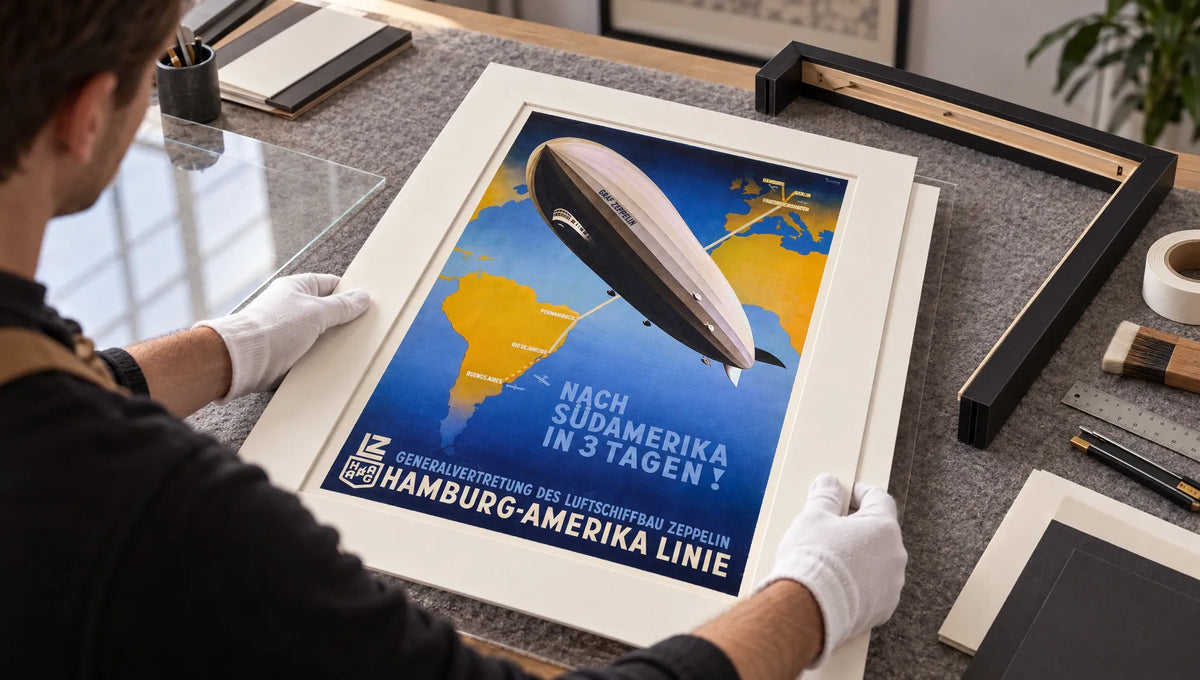
The Graf Zeppelin “Nach Südamerika in 3 Tagen” Vintage Poster offers a distinctive starting point. Its title translates as “To South America in 3 days,” capturing the promise of faster long-distance travel in the airship era.
As documented in Airships.net’s history of the Graf Zeppelin, the LZ 127 first flew in 1928 and became closely associated with transatlantic passenger service. Its long, rounded silhouette represents a different chapter of aviation from the familiar propeller airliner or jet.
That difference gives the subject its appeal. Airship enthusiasts see engineering history; travelers recognize the ambition of crossing an ocean; design collectors appreciate an advertisement that turns a journey into an aspiration.
In a home office or reading room, the poster can introduce that history without requiring a collection of aviation memorabilia. The artwork supplies the narrative, while the surrounding furniture remains contemporary.
What “framed prints vintage” means when you shop
A vintage subject does not establish that the physical print is old. Separate the age of the design from the age of the paper before comparing prices or conservation needs.
| Description | What it generally means | What to check |
|---|---|---|
| Original vintage print | A physical print produced during the earlier period it represents | Date, printing method, condition and ownership history where available |
| Modern reproduction | A newly produced print of an earlier design | Paper, dimensions, image quality and framing options |
| Retro or vintage-inspired artwork | A newer design that borrows an older visual language | Whether the subject and styling suit your collection |
| Antique print | Usually a print at least 100 years old, although usage varies | Evidence supporting its age and any restoration |
For an original, ask for photographs of the actual sheet, including its edges and reverse, plus details of repairs, fading or trimming. A compelling historical subject is not itself provenance.
For a reproduction, concentrate on presentation and suitability for your room. Check whether the product includes a frame. A photograph of framed artwork does not necessarily mean framing is part of the purchase.
Choose framing that supports the artwork
Aviation posters already contain strong shapes, lettering and visual direction. Their frames usually work best as quiet boundaries rather than competing decorative features.
Match the finish to the room
A slim black frame creates a clear outline against pale walls and works well alongside dark metal furniture. Natural oak softens the technical subject in Scandinavian-inspired interiors. Dark walnut can connect an airship print with a timber desk, leather chair or traditional bookcase.
For vintage framed prints, avoid choosing a distressed frame solely because the artwork looks historical. A clean contemporary profile often makes the contrast more appealing and keeps the room from feeling like a period set.
A mat can provide breathing room around the image. Warm white often sits comfortably beside aged-paper tones, but compare a sample with the actual print before ordering. Bright white can make a cream background appear unexpectedly yellow.
Ask for appropriate protective materials
For valuable originals, discuss conservation framing with a qualified framer. Cotton-rag or suitable conservation-grade mats, an appropriate backing and reversible mounting help protect the sheet without permanently altering it. Avoid adhesive tape against the artwork or irreversible dry mounting when preservation matters.
Glazing should remain separated from the printed surface. UV-filtering glass or acrylic can reduce ultraviolet exposure, but neither makes a print immune to fading from visible light. Acrylic is lighter and more impact-resistant than glass, although its static can be unsuitable for some fragile or powdery media.
Choose the wall position before paying for glazing upgrades. Transit Art’s guide to protecting vintage framed prints from sunlight explains why placement remains part of the protection strategy.
Size the complete frame, not just the poster
The dimensions on a poster listing usually describe the print rather than the finished object on your wall. Mats and frame moldings can increase its footprint considerably.
For example, a hypothetical 18-by-24-inch print with a 2-inch mat on every side has a 22-by-28-inch mat footprint before the frame molding is added. This is a planning example, not a statement about sizes available for any particular Transit Art product.
When arranging vintage framed prints above furniture, a grouping around two-thirds to three-quarters of the furniture’s width is a useful starting point, not a fixed rule. Leave enough space above a sofa or desk to prevent the arrangement from looking crowded or being knocked during everyday use.
Tape paper templates to the wall using the proposed outer frame dimensions. View them from the doorway and from your normal seated position. You will quickly notice whether the work feels too small, sits too high or competes with a nearby lamp.
For a pair, test a gap of roughly 2 to 3 inches, then adjust for frame size and wall space. Consistent spacing usually matters more than identical print dimensions.

Recommended Poster Pairings
A cohesive aviation wall needs a relationship between its subjects, not necessarily three identical-looking images. Start with the Graf Zeppelin poster, then choose a companion according to the mood you want. These two options can form separate pairs with the airship print or join it in a three-piece arrangement.
Swissair for a quieter travel pairing
The Swissair Vintage Travel Poster depicts an aircraft above the Swiss Alps. Paired with the Graf Zeppelin design, it connects two forms of air travel through the shared promise of reaching distant places.
The contrast between an airship subject and an Alpine flight scene gives the wall variety without leaving the aviation theme. Matching frame finishes and similar mat tones can supply continuity even when the compositions differ.
This pairing suits a reading corner, guest bedroom or calm home office. Place the prints side by side when their outer dimensions are similar, or align their centers if the finished frames differ in height.
Italian Aerial Lines for stronger color
The Italian Aerial Lines Poster features two red-and-white planes against a blue and yellow background. It brings a more pronounced color accent to a grouping built around the Graf Zeppelin print.
The two subjects complement each other through their transport-advertising heritage, while their different aircraft silhouettes keep the arrangement varied. In a dining area or creative workspace, let the Italian poster provide the main color cue and repeat just one of its colors in a nearby object.
If all three vintage framed prints share a wall, use a consistent frame profile to connect the airship, Alpine landscape and colorful aircraft composition. Lay out the combination before deciding which piece belongs in the center.
Make the aviation theme feel at home
The most convincing interiors leave room for the artwork to be discovered. A single aviation poster above a console can be more effective than filling every surface with related objects.
In a neutral living room, use the print as the main source of narrative. Keep larger furnishings understated and repeat one modest detail, such as the frame’s wood tone or a color from the artwork. The connection should be noticeable without becoming a decorating formula.
In a home office, an airship poster can sit comfortably beside technical books and practical task lighting. Avoid placing it where a desk lamp reflects directly in the glazing. In a hallway, check that the frame does not project awkwardly into a narrow walking route.
For a gift, choose the subject around the recipient’s interests rather than your own decorating scheme. An airship enthusiast may value the Graf Zeppelin story more than a generic aircraft image, while a traveler might connect more strongly with the Alpine scene.
Frequently Asked Questions
Are vintage aviation prints always original historical posters? No. The term can describe original period prints, modern reproductions or newly created retro-style designs. Read the product description and ask for evidence if a seller claims that a sheet is an original.
Should vintage framed prints have a mat? Not always. A mat can separate the image visually from the frame and help keep the paper away from glazing. A qualified framer can also use spacers when a mat-free presentation better suits the artwork.
Can I buy an aviation poster and arrange framing separately? Yes. This lets you choose the frame finish, mat and glazing for your room. Confirm the print’s exact dimensions and whether it includes borders before ordering a ready-made frame or commissioning custom work.
Do all the posters in an aviation gallery wall need matching frames? No, but one repeated feature helps. Matching finishes, similar profiles or consistent mats can connect different subjects. If both the artwork and frames vary strongly, keep the arrangement smaller and the spacing deliberate.
Choose a story, then give it space
A successful vintage aviation wall combines a subject worth looking at with framing that belongs in the room. Start with the Graf Zeppelin poster if airship history captures your imagination, then consider Swissair or Italian Aerial Lines as a complementary view of travel. Measure the finished arrangement, check what each purchase includes and let the artwork, rather than extra themed accessories, establish the atmosphere.

