Artikel: Choosing Vintage Travel Posters for an Aviation-Themed Den
Choosing Vintage Travel Posters for an Aviation-Themed Den
Choosing Vintage Travel Posters for an Aviation-Themed Den
A search for “travel posters vintage” can uncover everything from glamorous airline advertisements to newly illustrated retro prints. For an aviation-themed den, the most satisfying choice is rarely the poster with the biggest aircraft. It is the one that gives the room a story, suits the way you spend time there and holds your attention beyond the first glance.
Think of the den as a comfortable place to read, listen to music or share a drink, with aviation woven into its character. A Paris-to-London advertisement can establish that atmosphere without requiring a room full of aircraft memorabilia.
Decide What Kind of Aviation Story Your Den Should Tell
Before comparing prints, choose the aspect of flight that interests you most. Early passenger travel suggests elegant lettering, international routes and the promise of arrival. Aircraft-centered imagery puts engineering in the foreground. Cabin scenes introduce a more domestic perspective, showing how travelers experienced the journey.
These approaches create different moods. A dramatic aircraft image can energize a home office corner, while an advertisement emphasizing passenger comfort may feel more at home beside a reading chair.
Keep the room’s existing character in view. Dark bookcases, leather upholstery and warm lighting can support interwar airline imagery, but pale oak and simple linen furnishings work just as well. The connection comes from proportion and color, not from recreating an airport lounge.
Choose one organizing idea, such as European air routes or the experience of early passenger flight. That gives later additions a reason to belong.
Understanding “travel posters vintage”: Original, Reproduction or Retro?
The word vintage can describe either an object’s age or its visual style. That distinction matters when you are comparing prices and deciding how carefully a print needs to be handled.
Historical originals
An original period advertisement was printed during the era it promoted. Its value depends on factors including rarity, condition, artist and provenance. Ask the seller about printing date, restoration, backing and ownership history. Yellowed paper alone does not establish authenticity.
Reproductions and new retro designs
A reproduction presents an existing historical image as a newly made print. A retro-inspired design is a newer composition that borrows older visual conventions. Neither should be described as an original period artifact.
For a den intended for everyday use, a reproduction offers a practical way to enjoy historical advertising without making the room revolve around the care of a collectible. Clear product descriptions matter more than artificial signs of age.
If you are still narrowing your preferences, Transit Art’s guide to choosing vintage posters by illustration style and era can help distinguish Art Deco geometry from softer, painterly travel imagery.
Make the Golden Ray Paris-to-London Print Your Starting Point
Transit Art’s Art Deco Aviation Poster, E. Maurus “Golden Ray Air Union” is a reproduction of a historic advertisement for the Paris-to-London service. Credited to E. Maurus, the design connects aviation with the sophisticated travel culture of the interwar years.
Air Union was among the airlines brought together to form Air France in 1933. That background gives the image a specific place in commercial aviation history, rather than leaving it as a generalized celebration of old airplanes.
Art Deco is a particularly useful starting point for vintage travel posters because its structured compositions and stylized imagery can sit comfortably alongside modern furniture. As Encyclopaedia Britannica’s overview of Art Deco explains, the style combined decorative appeal with an affinity for modernity and machine-age forms.
For aviation enthusiasts, the Golden Ray subject offers a recognizable airline story. For design-minded viewers, its appeal can be the relationship between illustration, lettering and space. For someone with a personal connection to Paris or London, the route adds another layer of meaning.
Let that combination guide the room. The print does not need neighboring objects that repeat its subject literally; books, a comfortable chair and a well-chosen lamp can provide all the context it needs.
Design the Display Around the Seat, Not Just the Wall
Choose scale from the furniture below
A den is usually experienced from a chair or sofa, so judge artwork from that position before fixing its height. A print that looks balanced while you are standing may feel disconnected when you sit down.
As a starting point, try an artwork grouping around two-thirds the width of the furniture beneath it. This is a design guide, not a requirement. Leave enough space around nearby shelving, switches and door trim for the arrangement to feel intentional.
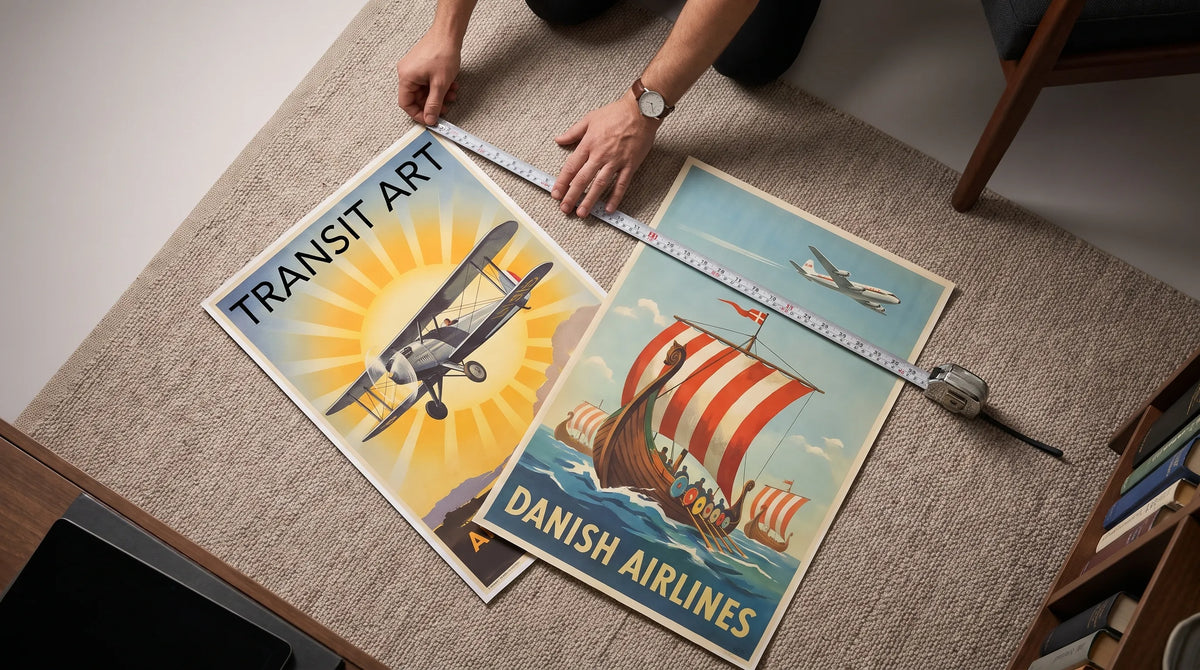
Use paper templates to test the outside dimensions of the frames, not just the advertised print sizes. Mats and frame profiles can substantially change the finished footprint.
Borrow colors selectively
Vintage travel posters work best when their colors connect to the room without being repeated everywhere. Pick one secondary shade from the artwork for a cushion, book jacket or small ceramic object. Keep larger furnishings quieter if the print is visually busy.
A restrained black frame can connect different airline advertisements. A light wood frame may suit a Scandinavian interior, while a darker timber can relate to an existing desk or bookcase. Matching frame finishes often creates more cohesion than forcing every poster into the same palette.
Check the view after dark
The den’s evening lighting matters as much as its daylight appearance. Position a temporary print-sized sheet on the wall, sit in your usual chair and check whether a lamp or window reflects across it.
Avoid prolonged direct sunlight and locations near fireplaces or damp exterior walls. For glazing choices, ask a framer about UV-filtering and anti-reflective options; they address different problems, and neither makes a print immune to light damage.

Recommended Poster Pairings
With the Golden Ray reproduction as the focal piece, choose companions that add another part of the travel experience. These two Transit Art posters offer different ways to develop the story without filling the wall with near-identical aircraft views.
Danish Airlines: Add the Energy of Departure
The Vintage Airline Travel Poster, Det Danske Luftfartsselskab depicts an orange airplane above a crowd waving goodbye. The people give the scene an emotional dimension: flight becomes a shared occasion rather than an isolated machine in the sky.
Beside the Golden Ray print, it broadens the theme from one international route to the wider excitement of European air travel. Use the orange aircraft as a possible accent-color reference, but compare both product images before choosing accessories.
This pairing would suit the wall above a low bookcase. Coordinated frames can unite the different compositions while leaving each airline identity distinct.
Imperial Airways: Bring the Journey Inside
The Imperial Airways “Comfort in the Air” Vintage Poster shows a passenger being served in a cabin and includes an airline route map. It shifts attention from the aircraft’s exterior to the experience of being on board.
That makes it a thoughtful companion for the Golden Ray advertisement. One evokes the promise of traveling between cities; the other introduces service, comfort and the journey itself.
Place this print near a reading chair or drinks cabinet, where its subject relates naturally to the room’s use. If you display all three vintage travel posters together, let the Golden Ray remain the visual anchor rather than assuming every image needs equal emphasis. Test the complete arrangement with templates before ordering sizes.
Check the Print Details Before Choosing a Frame
Transit Art describes its poster range as using FSC-certified paper and a gallery-quality finish. FSC certification concerns responsible forest sourcing; it does not establish the age of an image or guarantee that a print will never fade.
On the individual product page, check the available dimensions and what is included. Do not assume a frame shown in a room photograph comes with the print. Where dimensions or borders are unclear, confirm them before ordering a custom frame.
For a considered finish, discuss conservation-quality mats and reversible mounting with your framer. A mat can also give a densely illustrated advertisement more breathing room, especially when neighboring bookshelves already make the wall visually active.
Frequently Asked Questions
Can I mix advertisements from different airlines? Yes. Connect them through a shared era, region or travel story, then use framing to establish consistency. A departure scene and a cabin scene can make a more engaging pairing than several nearly identical aircraft compositions.
Should aviation art match the other objects in my den? It needs a relationship with the room, not an exact match. Repeat one color or material, then allow some contrast. Contemporary furniture can keep historical imagery from making the space feel like a period set.
Are reproductions a good choice for vintage travel posters? Yes, provided they are clearly identified. A reproduction lets you enjoy a historical design without treating it as an original collectible. Choose for image appeal, print quality and suitability for your space rather than an ambiguous vintage label.
How many posters should I hang in a small den? Start with one focal print. Add a companion only if the wall and surrounding furniture leave enough room. A single well-scaled piece often feels more deliberate than several small prints squeezed between shelves.
Give the Room a Personal Flight Path
An aviation-themed den feels most convincing when the artwork reflects a genuine interest: a favorite route, an admiration for early airline design or memories of travel. Start with the Golden Ray Paris-to-London reproduction if that story resonates, then choose a companion that adds something different.
Measure the wall, test the layout and look at it from your favorite seat. The aim is a room you enjoy spending time in, with aviation history as part of its character.