Artikel: Engineering Posters for an Industrial Home Office
Engineering Posters for an Industrial Home Office
A home office can reflect an interest in machines without looking like a workshop. Engineering posters bring structure, movement and mechanical character to a room, particularly when paired with wood, dark metal and a restrained color palette. The most convincing arrangement connects the artwork to something you genuinely appreciate: an elegant mechanism, a historic race or the practical beauty of transport design.
For an industrial interior, the aim is balance. Choose art with a strong subject, give it enough space to stand out and let the furniture support it rather than compete with it.
What Makes Artwork Feel Industrial?
Industrial interiors draw much of their character from exposed materials and functional forms. Steel shelving, timber desktops and visible brickwork provide texture, but artwork supplies the personal connection that these materials cannot provide alone.
Mechanical subjects fit naturally because they share that emphasis on purpose. A locomotive, sports car or technical illustration can draw attention to proportion, construction and movement. Vintage transport advertising adds another layer: it shows how manufacturers and railway companies communicated speed, reliability and modernity to earlier generations.
You do not need exposed pipes or a concrete floor to make this work. A simple desk with black legs, a warm wooden surface and one thoughtfully framed print can establish the same relationship between utility and design. In a room that already has plenty of texture, quieter framing helps keep the wall from feeling crowded.
How to Choose Engineering Posters for Your Workspace
Start by deciding whether you want to celebrate engineering itself or the culture surrounding it. These are related interests, but they produce different kinds of artwork.
Technical Drawings or Transport Art?
Blueprints, cutaway illustrations and labeled diagrams focus on how a machine is constructed. They suit viewers who enjoy studying components and relationships. If accuracy matters to you, check whether the drawing identifies its subject and whether its annotations are meaningful rather than decorative.
Motorsport and railway posters focus more on what machines accomplish. They express speed, endurance or the movement of goods through composition and color. A racing poster is not an engineering diagram, but it can be an excellent choice for an engineering-minded office.
Also consider viewing distance. Fine annotations reward close inspection, while bold silhouettes and expressive lettering remain readable across a room. Above a desk, either approach can work; on a wall farther from your chair, a simpler composition usually makes a clearer focal point.
The Engineering Story Behind Le Mans Racing Art
For motorsport enthusiasts, engineering posters can celebrate the demands placed on a machine rather than show its individual parts. Endurance racing makes that connection especially tangible.
First held in 1923, the 24 Hours of Le Mans tests cars over a full day and night. Outright speed matters, but so do cooling, braking, fuel management and the ability to keep running. That combination gives Le Mans artwork an appeal beyond the excitement of a single racing moment.
The 1954 race was won by José Froilán González and Maurice Trintignant in a Ferrari 375 Plus. For someone interested in automotive history, the period connects powerful sports-racing machinery with the practical challenge of sustained competition.
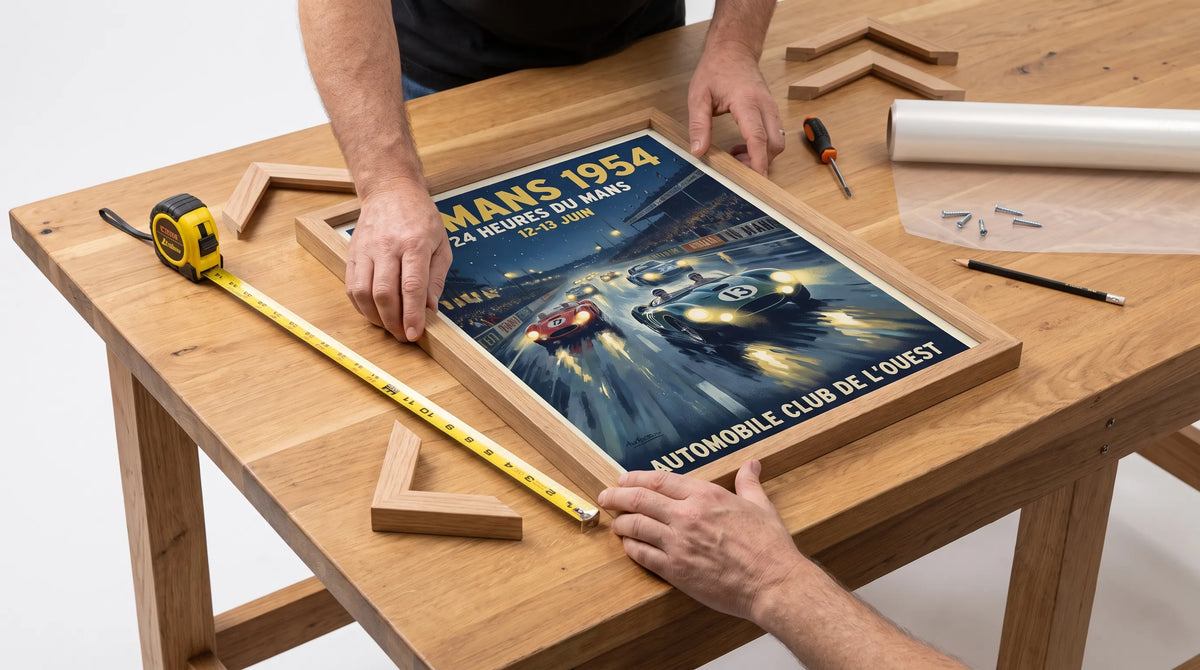
Transit Art’s 1954 24 Heures du Mans Night Racing Poster captures the atmosphere of that challenge. A red number 4 race car charges through a glowing night circuit with its headlights blazing. Other cars stream beneath the Dunlop bridge, while yellow typography and fluid blue brushstrokes reinforce the sense of movement.
Its appeal is not limited to Ferrari fans or race historians. Designers may appreciate the energetic composition, while engineers and automotive enthusiasts can connect with the endurance-racing subject. The artwork gives an otherwise restrained office a vivid focal point without requiring a room full of memorabilia.
Styling an Industrial Home Office Around the Artwork
Build a Restrained Material and Color Palette
Engineering posters work best in an industrial office when the surroundings give their details room to breathe. Start with a few compatible materials: a timber desk, black metal lighting and a neutral wall are enough.
For the Le Mans print, use its red, blue and yellow selectively. A muted blue storage box or a small red desk accessory can establish a connection without repeating every color in the artwork. Let the print remain the brightest element.
Warm white walls soften dark furniture, while light gray can create a more workshop-like setting. If the room already contains exposed brick, choose a frame and mat that separate the artwork from that busy background. Industrial styling does not require every surface to be dark or distressed.
Choose Scale Before Choosing a Layout
Measure the usable wall area, including shelves, sockets and the height of your monitor. The artwork should relate to the desk rather than simply fill whatever space remains above it.
As a starting point, a framed arrangement spanning roughly half to two-thirds of the desk width often feels balanced. For a 60-inch desk, that means an overall framed width of about 30 to 40 inches. These are layout examples, not product-size specifications; check the available print sizes and account for the frame before ordering.
| Office setup | Suggested arrangement | Design benefit |
|---|---|---|
| Compact desk against a plain wall | One framed print centered over the desk | Establishes a clear focal point |
| Wide desk with open wall space | Two prints with aligned top edges | Creates a coordinated display |
| Desk beneath shelving | One print on an adjacent wall | Avoids crowding the working area |
| Shared office | A related print above each workspace | Connects the room while allowing individual interests |
Keep the Working Area Visually Calm
Check the arrangement from your seated position as well as from the doorway. A monitor should not obscure the most interesting part of the image. If the wall above your desk is crowded, move the artwork beside the desk or onto the wall opposite it.
Lighting deserves the same attention. Position a task lamp so it illuminates your work without producing a bright reflection in the frame. Before hanging anything permanently, hold the framed piece in place at different times of day to check glare from windows.

Recommended Poster Pairings
A cohesive gallery wall does not need every image to depict the same event. A shared interest in machines can provide the connection, with matching frames and measured spacing giving the arrangement structure. The following are two alternatives for pairing with the Le Mans print, rather than a requirement to display all three together.
Amilcar for a French Automotive Theme
The Le Grand Sport Amilcar Vintage Poster offers a complementary French automotive subject. Founded in 1921, Amilcar became associated with light sporting cars, making the marque an interesting companion to the endurance-racing heritage of Le Mans.
This pairing connects two aspects of automotive culture: the appeal of a sporting road car and the drama of competition. It suits the main wall of a home office used by a classic-car enthusiast, especially when the surrounding furniture is simple.
Use matching frame finishes to unify the pieces. Before selecting mats, compare the background tones shown on the product pages rather than assuming that all vintage posters share the same cream-colored paper effect.
Dutch Railways for a Broader Transport Theme
For readers choosing engineering posters around a wider interest in transport, the Dutch Railways Cargo Poster introduces railway machinery. Its steam locomotive and bold red-and-blue colors create a connection with the Le Mans print’s racing subject and expressive palette.
The contrast is useful: one image celebrates speed on a circuit, while the other concerns freight transport. Together, they give an office a broader mechanical identity without turning the wall into a collection of unrelated vehicles.
This pair works well above a sideboard or on a wall beside the desk, where both prints can be viewed together. Keep their spacing consistent and align either the frame tops or their centers, depending on the chosen sizes.
Frame and Protect the Prints Thoughtfully
A slim black frame echoes metal desk legs and shelving. A simple wood frame can soften the arrangement if the room already contains a lot of dark steel. Neither choice needs artificial distressing to feel appropriate.
If you want more separation between a detailed poster and a textured wall, Transit Art’s guide to choosing mat borders for paper posters explains the practical decisions involved.
Transit Art’s poster offering includes FSC-certified paper, which concerns responsible paper sourcing. Display conditions still matter: avoid direct sunlight, damp areas and positions immediately above a radiator. UV-filtering glazing can help reduce light exposure, but it does not eliminate the need for sensible placement.
Frequently Asked Questions
Are engineering posters always blueprints? No. The term can include technical drawings, machinery illustrations and engineering-inspired transport art. Choose a diagram if you want construction details or a racing and railway print if you prefer historical atmosphere and visual impact.
Can colorful racing artwork suit an industrial office? Yes. Neutral walls, timber and black metal provide a restrained setting for a colorful print. Repeat one accent color elsewhere in the room rather than trying to match the entire artwork.
Should paired posters have identical frames? Matching frames are an easy way to create cohesion, but identical print dimensions are not essential. Consistent spacing and deliberate alignment can bring differently sized pieces together.
Where should artwork go if a monitor covers the wall above the desk? Use an adjacent wall or a space above a low cabinet. The best position is one where the artwork remains visible without interfering with shelves, lighting or everyday work.
Create a Workspace That Reflects Your Interests
The strongest industrial offices combine useful furniture with artwork that means something to their owner. Engineering posters can express an interest in mechanical design, but the choice should come from the subject you enjoy, not simply from a decorating label.
Start with one print, measure its position and build around it gradually. A Le Mans racing scene, an Amilcar sporting-car poster or a railway companion can give the room a distinct character while keeping the workspace comfortable and uncluttered.