Artikel: Racing Posters for a Gallery Wall With Motorsport Spirit
Racing Posters for a Gallery Wall With Motorsport Spirit
Racing posters work best when they do more than fill wall space. The strongest motorsport art carries speed, engineering, memory and atmosphere into a room, turning a hallway, studio or living space into a place with a point of view. For anyone drawn to classic cars, a gallery wall can become a compact history of competition.
That is why the pairing of a Mercedes-Benz 300 SLR at Le Mans and a classic Bugatti in a garage feels so natural. One image speaks of endurance racing at its most intense. The other captures the quiet confidence of a French marque that helped shape Grand Prix culture in the early twentieth century.
Why racing posters give a gallery wall motorsport spirit
A motorsport gallery wall is not simply a row of car pictures. It is a rhythm of motion and stillness, track and workshop, bright color and shadow. The best racing posters help a room feel curated because they suggest a story that continues beyond the frame.
For car enthusiasts, this emotional charge is obvious. A race car is never just a machine. It is linked to a driver, a circuit, a rulebook, a technical solution and a particular era of design. In a home, that background gives automotive art more depth than ordinary decoration.
For interior design lovers, the attraction is visual. Long bonnets, spoked wheels, streamlined bodywork and racing numbers create strong graphic shapes. Black-and-white garage scenes bring contrast and restraint, while painted Le Mans scenes add warmth, light and drama.
The Mercedes-Benz 300 SLR, speed, light and Le Mans memory
The Mercedes-Benz 300 SLR is one of the most evocative racing cars of the 1950s. Based on Mercedes' postwar competition knowledge, it was built for endurance events where speed alone was not enough. Reliability, balance and aerodynamic efficiency mattered just as much as power.
The car is inseparable from names like Juan Manuel Fangio and Stirling Moss. Moss and Denis Jenkinson famously won the 1955 Mille Miglia in a 300 SLR, a drive that remains one of the great performances in road racing history. At Le Mans in the same year, the car arrived as a major contender, but the event is also remembered for one of motorsport's darkest tragedies. That tension gives any serious image of the 300 SLR a deeper historical weight.
Sune Envall's oil painting of the 300 SLR
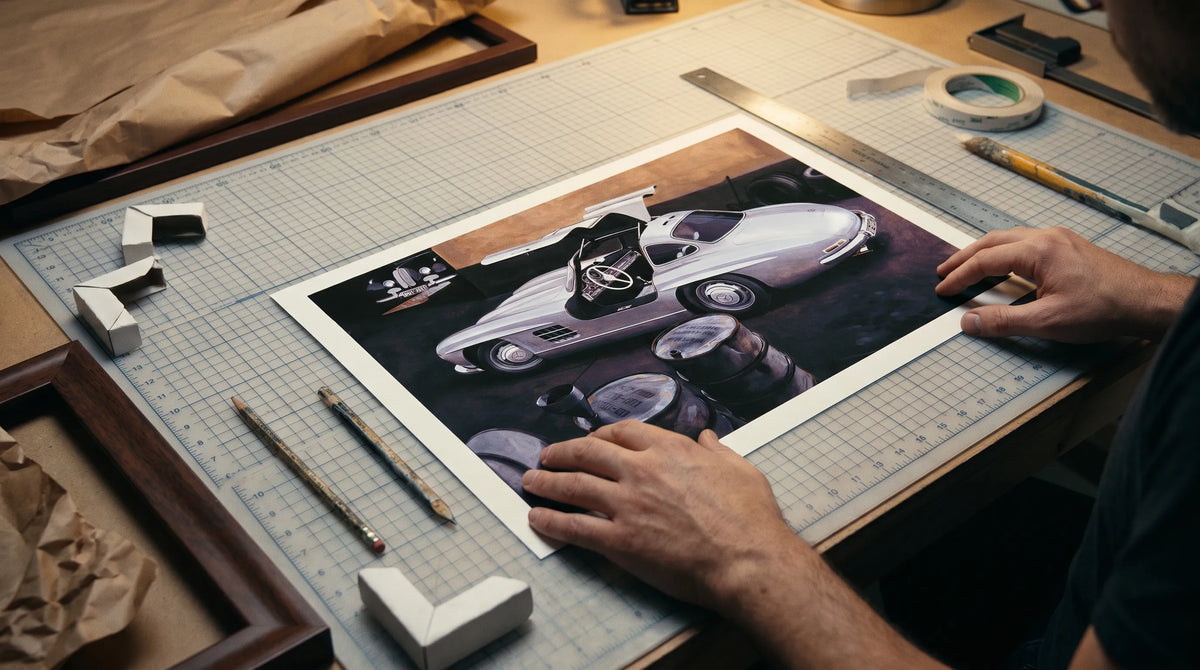
The artwork behind The Mercedes-Benz 300 SLR at Le Mans 1955 was made in oil by Sune Envall, and that matters. Oil painting gives metal, air and reflected light a physical presence that a flat digital image often cannot match.
In the scene, the Mercedes 300 SLR is shown after exiting the area associated today with the Dunlop bridge, although that present-day reference point was not there at that time. This small historical distinction gives the image a layered quality. We see Le Mans through modern memory, but the car belongs to 1955.
For collectors, racing posters based on this kind of original painting offer something different from a photographic print. The light is not merely recorded, it is interpreted. Sune spent years mastering illustrated light, in the tradition of master painters who understood that illumination can guide the eye, shape emotion and make a moment feel alive.
Bugatti and the romance of racing engineering
Bugatti's story begins with Ettore Bugatti, the Italian-born designer who founded the marque in Molsheim, then in the German Empire and later part of France. From the start, Bugatti cars were admired for their elegance as much as their performance. They looked delicate, but they were formidable competition machines.
The Bugatti Type 35 became one of the defining racing cars of the 1920s. Its proportions were compact and purposeful, its engineering was refined and its competition record helped establish Bugatti as a serious force in Grand Prix racing. The brand's cars were not crude instruments of speed. They were precise, beautifully finished and instantly recognizable.
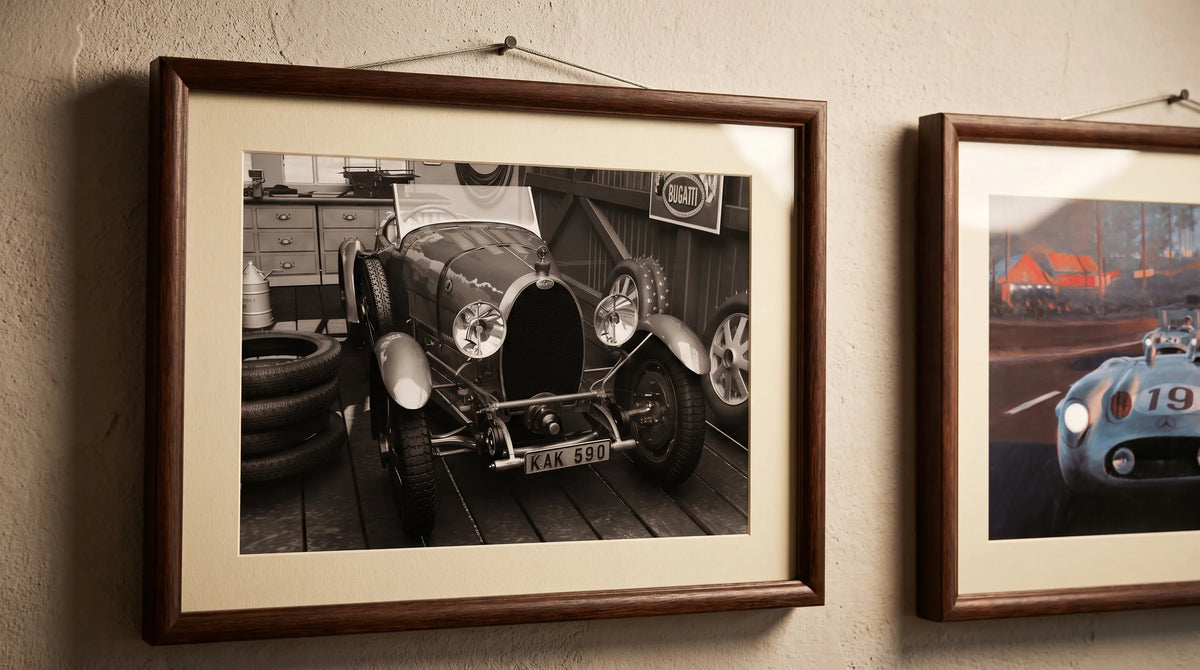
That is what makes Bugatti in garage - BW such a useful anchor for a gallery wall. Rather than showing the car at full speed, it places a classic Bugatti inside a garage. The black-and-white treatment emphasizes shape, shadow and craftsmanship. Bugatti art also shows why racing posters do not always need motion to feel dynamic, sometimes the anticipation before a race is just as powerful.

How to style racing posters in modern interiors
When choosing racing posters for a home, start with the mood you want the room to carry. A living room can handle larger, more atmospheric work, especially if the furniture is simple and the wall color is calm. A home office benefits from focused pieces that suggest ambition, concentration and mechanical discipline.
Classic car art works especially well in interiors that use natural materials. Walnut, oak, leather, brushed metal, linen and wool all sit comfortably beside automotive subjects. They echo the physical world of garages, cockpits and grandstands without making the room feel themed.
A good rule is to balance movement with rest. If one poster shows a car in action, pair it with a quieter garage or pit image. If one piece is rich with warm light, place a monochrome print nearby to keep the composition grounded.
| Interior style | Poster approach | Why it works |
|---|---|---|
| Minimalist | One large motorsport print with a thin black frame | Creates a focal point without clutter |
| Scandinavian | Warm painted car scenes with pale wood frames | Adds character to a light, neutral room |
| Industrial | Black-and-white garage imagery with metal or black frames | Matches brick, concrete, steel and leather |
| Classic study | Historic race cars in deeper tones | Feels refined beside books, wood and vintage objects |
| Modern apartment | A three-piece automotive gallery wall | Gives personality to clean architecture |
In a home office, racing posters can also become a subtle expression of mindset. Endurance racing, engineering discipline and design precision are all ideas that fit naturally into a workspace without feeling corporate.
Recommended Poster Pairings
A strong set of racing posters should feel connected, but not repetitive. The goal is to create a conversation between cars, eras and visual moods. These Transit Art pairings work well for a motorsport-inspired gallery wall.
| Poster | Why it pairs well | Ideal placement |
|---|---|---|
| The Mercedes-Benz 300 SLR at Le Mans 1955 | The painted light and Le Mans setting make it a natural centerpiece for an endurance racing wall. | Above a sofa, desk or sideboard |
| Bugatti in garage - BW | The monochrome garage atmosphere balances the drama of the Mercedes scene with quieter mechanical elegance. | Beside a reading chair or in a study |
| German Rivals | Auto Union history adds another chapter of prewar European racing design and creates a strong historical bridge. | In a three-print motorsport row |
| Le Mans pits | A pit-focused McLaren F1 subject connects classic endurance racing with a later icon of automotive performance. | Home office or media room |
| LeMans Night | Night racing atmosphere adds contrast, depth and a cinematic mood to the composition. | Lower-lit lounge or hallway |
For a compact wall, choose three prints: the Mercedes 300 SLR as the central piece, the Bugatti garage image on one side and German Rivals on the other. For a larger wall, add the Le Mans pit and night racing pieces to create a broader endurance racing narrative.
Framing, spacing and color choices
Frames change how automotive art reads in a room. A thin black frame gives classic car prints a museum-like sharpness. Natural wood softens the mood and works well in Scandinavian or mid-century interiors. Silver or dark metal frames can look strong in industrial spaces, especially when the subject includes mechanical details.
Spacing matters as much as the prints themselves. Leave enough air between frames for each image to breathe, usually a consistent gap creates the cleanest result. If the posters vary in tone, place the darkest image toward the lower part of the arrangement or use it as a visual anchor on one side.
Transit Art prints are designed for home display, with gallery-quality poster finishes, multiple sizes and FSC-certified paper printing across the collection. When selecting racing posters, consider both the subject and the room's existing palette. Warm oil-painted scenes can lift beige, cream and brown interiors, while black-and-white automotive prints suit monochrome, charcoal and steel accents.
Frequently Asked Questions
Are racing posters only for car enthusiasts? No. Motorsport art appeals to enthusiasts first, but it also works for people who appreciate industrial design, vintage graphics, strong composition and interiors with character.
Can I mix black-and-white car prints with painted racing scenes? Yes. In fact, the contrast often makes a gallery wall stronger. A monochrome Bugatti garage image can calm the composition while an oil-painted Le Mans scene adds movement and light.
Where should I hang classic car posters? Living rooms, home offices, hallways, studios and media rooms are all good choices. The best placement is usually where the artwork can become a focal point rather than background decoration.
How many prints should I use in a motorsport gallery wall? Three prints are enough for a focused arrangement. Five work well on a wider wall if the subjects share a theme, such as endurance racing, prewar engineering or classic European marques.
Bring motorsport history into the room
The most memorable automotive interiors are not built from decoration alone. They come from choosing art that means something, then giving it space to speak. A Mercedes 300 SLR scene carries Le Mans history, painted light and the drama of 1950s endurance racing. A Bugatti garage image brings French elegance, engineering culture and quiet anticipation.
Together, these racing posters create more than a themed wall. They create atmosphere. For enthusiasts looking to bring motorsport heritage into a living room, study or creative workspace, a curated Transit Art gallery wall offers a way to live with the machines, stories and design language that continue to inspire classic car culture.