Artikel: How to Choose Home Wall Art When Your Tastes Differ

How to Choose Home Wall Art When Your Tastes Differ
Choosing home wall art together can reveal differences you barely noticed before. One person wants a dramatic car print above the sofa; the other prefers something quiet and understated. Start by agreeing on the room’s mood, then choose artwork that gives both people something to enjoy. You do not need identical tastes or a picture that neither person particularly likes.
The most useful distinction is between the subject of an artwork and its presentation. A transport print can appeal through engineering, travel memories, color or composition. This guide helps you identify the real disagreement, build a shared shortlist and test an arrangement before buying.
Identify why your decorating tastes differ
“I don’t like automotive art” might mean “I don’t want bright racing colors dominating our living room.” Likewise, “minimalist prints are boring” might mean “I want something with a story, not just a shape.” Those are different objections, with different possible solutions.
Before discussing individual posters, identify which part of the choice is causing friction. Use this table as a conversation starter rather than a set of decorating rules.
| Point of disagreement | What to discuss | A practical starting point |
|---|---|---|
| Subject | Whether the theme has meaning for both people | Look for a connection through travel, design or a shared memory |
| Color | Whether the artwork feels too strong or too subdued | Agree on a limited palette before browsing |
| Visual energy | Whether the composition feels busy or empty | Compare detailed scenes with simpler vehicle portraits |
| Size | Whether the artwork should dominate the room | Test its footprint with paper wall templates |
| Personal ownership | Whether one person’s interests fill every wall | Reserve space for shared choices and individual favorites |
Try describing three prints you like without naming their subjects. Words such as precise, nostalgic, playful or spacious reveal preferences that “cars versus abstract art” can conceal.
The aim is not identical taste. Look for home wall art that satisfies different interests through shared visual qualities: one person appreciates the vehicle while the other enjoys the lines, spacing or palette.
Build a shared brief for home wall art
Start with the room, not the shopping shortlist
Choose a few words for the atmosphere you want: calm and warm, lively and colorful, or clean and architectural. Use those words as a filter rather than treating either person’s favorite style as the default.
Decide where the artwork belongs before debating how expressive it should be. You might prefer a quieter composition in a shared living room, a characterful pair in the hallway or an enthusiast’s favorite subject in a home office.
Set a total budget at this stage too. Include the print, frame, mat if wanted and delivery costs. A shared budget gives you another clear filter without making taste the deciding factor in every rejection.
Name one priority each
Each person should identify one feature they genuinely care about. That could be a railway subject, generous negative space, warm colors or vintage illustration. Then distinguish that priority from preferences that are flexible.
For example, a transport enthusiast might care about the subject but happily accept a restrained palette. Their partner might care about visual calm without objecting to a train or bicycle. Choosing home wall art becomes easier when you know which decisions need agreement and which can remain flexible.
Avoid turning every preference into a veto. If you reject a print, explain the specific reason and suggest an alternative that preserves something the other person values.
Give both people a visible role
Consider choosing one artwork jointly, selecting one print each for a coordinated pair or giving separate areas different personalities.
One person choosing the subject while the other chooses the frame is worth trying, but only if both enjoy the finished piece. Framing is not equal compensation for disliking the artwork itself. Aim for positive agreement, not reluctant permission.
Choose wall art size, color and frames together
Test the size before rejecting the design
Before dismissing a print as overwhelming, test it at a smaller size. Measure the available wall and the furniture below it, then tape up paper templates representing the options you are considering. Include the frame’s outer dimensions, not just the printed image.
View the templates from the doorway and your usual seating position. Try different heights and notice whether you like the relationship between the artwork and the furniture. This turns “too much” into a discussion about actual proportions.
For a concrete starting point, Transit Art’s Monaco Grand Prix 1936 listing offers 12 × 16, 20 × 28 and 28 × 40-inch options. Check the selected size and regional measurements before buying a frame. (transitart.com)
Connect different styles through presentation
When home wall art represents different interests, try using shared presentation to connect the pieces without erasing their differences. Compare matching frames for a car poster and a railway print, or similar mat proportions for two contrasting compositions.
Rather than repeating every color in a print elsewhere in the room, choose one connection to test: an accent color, a compatible background tone or a consistent frame finish. Leave room for the artwork to have its own character.
For more layout ideas, Transit Art’s guide to creating a cohesive gallery wall with framed prints covers frames, colors and spacing. (transitart.com)
Decide how much emphasis each piece should have
Try a larger shared choice as the room’s anchor, with smaller personal selections nearby. Alternatively, compare two equally sized prints if you want both people’s preferences to have equal space.
For an open-plan home, consider separate zones with different personalities and one connecting element, such as frame color. Transit Art’s guide to using wall art to anchor an open-plan living space explores arrangements around distinct activity areas. (transitart.com)

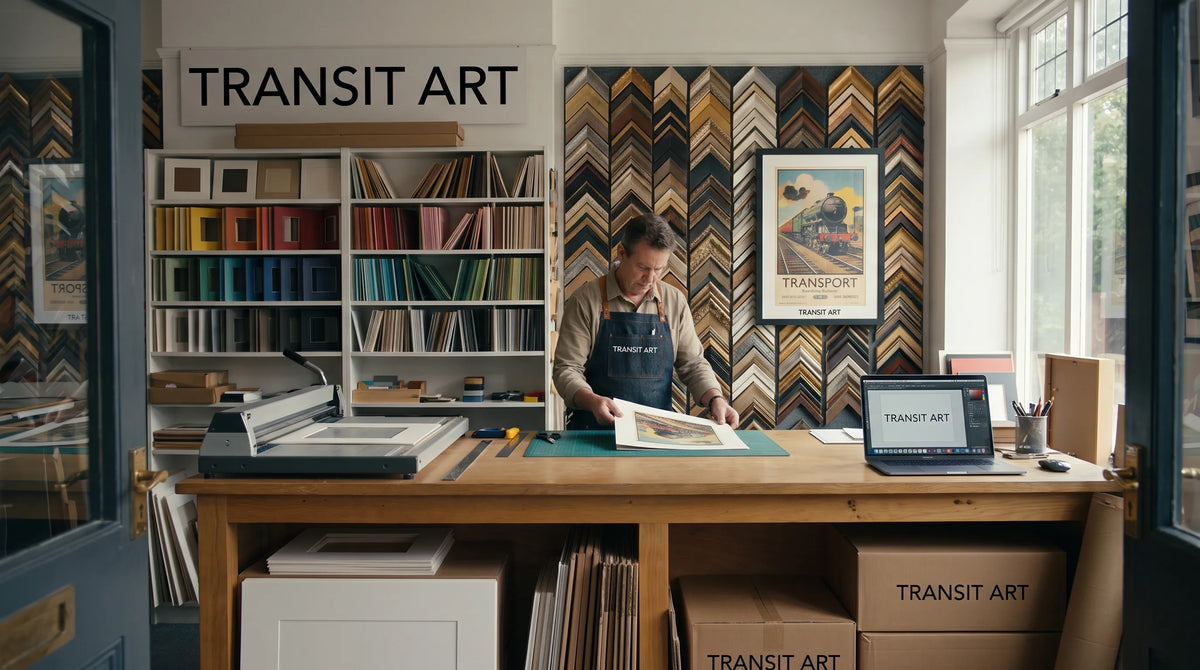
Use the room setting as inspiration, not as confirmation of what your order includes. Check the product listing before assuming a pictured frame is supplied.
Transit poster pairings to compare for your shared wall
Use the following home wall art combinations as shortlisting ideas, not automatic matches. The links lead to individual Transit Art listings. Compare the images, sizes and finishes before deciding whether the pieces belong together in your room.
Monaco Grand Prix 1936 and Michelin Bicycle Tires: expressive vintage graphics
Start with Monaco Grand Prix 1936 for the automotive enthusiast. The vintage illustration depicts a racing car taking a curve during the Monaco Grand Prix. If motorsport is not a shared interest, ask whether the other person enjoys the composition and vintage styling independently of the subject. (transitart.com)
Compare it with Michelin Bicycle Tires: Best and Most Affordable. This advertising design features the Michelin Man riding a bicycle against a blue background, with prominent lettering. Consider it for someone who enjoys playful illustration rather than someone seeking a quiet bicycle silhouette. (transitart.com)

Try this pair if both people like expressive vintage graphics but prefer different transport subjects. Compare equal outer frame sizes above a hallway console or office cabinet. If the combination feels too busy for your shared brief, keep one as an individual favorite rather than forcing both onto the main wall.
Southern Railway “Gateway to the Seas” and Winter break: different views of travel
The Southern Railway “Gateway to the Seas” Vintage Poster offers common ground within a single design. It combines an ocean liner and a steam locomotive with Southampton lettering, bringing rail and maritime interests into the same image. Shortlist it if both people enjoy transport subjects and bold typography. (transitart.com)

For a second print, compare Winter break, Sune Envall’s illustration of the Swedish coastal vessel S/S Storskär in a winter harbor in the Stockholm archipelago. Its harbor subject offers a different starting point from the railway poster’s travel-advertising composition. (transitart.com)
Treat this as a contrast to test, not a guaranteed match. One person may prefer the railway poster’s lettering while the other connects with the harbor scene. View the images side by side, then decide whether to use matching frames or place them in separate areas.
If you only want one shared piece, consider “Gateway to the Seas” on its own before committing to a pair.
Check paper finish and framing details
Compare finish as well as subject and size. The Monaco Grand Prix 1936 and Winter break listings describe matte, uncoated paper. The Michelin Bicycle Tires and Southern Railway listings describe semi-glossy paper. Do not assume every poster from the same store has an identical finish. (transitart.com)
Choose the finish because it suits your shared plan, not because one option is automatically more sophisticated. Check the selected dimensions, border details and what each order includes before purchasing frames.
Test your shortlist before buying
Once you have a shortlist, give it a few days rather than deciding at the end of a long browsing session. Keep your paper templates in place and use the actual product images for a simple side-by-side comparison.
For home wall art that both people enjoy, ask each person to explain what they like about the proposed arrangement. The reasons can differ: one may love the transport subject while the other values the composition. If the answer is only “I don’t mind it,” keep looking or reconsider the placement.
Use a short final check before ordering:
- Shared appeal: Can both people name something they genuinely enjoy?
- Room fit: Have you tested the full framed dimensions on the wall?
- Presentation: Have you agreed on frames, spacing and placement?
- Purchase details: Have you checked size, finish, order contents and total cost?
A favorite interest does not have to become the main focal point. If a print remains divisive, reserve it for an agreed personal space and choose something else for the shared wall.
Frequently Asked Questions
How do you choose home wall art when your tastes differ? Agree on the room’s mood first, then identify one priority each. Compare artwork by subject, color, composition and size rather than accepting or rejecting an entire style. Test a small shortlist on the wall before buying.
Can you mix different art styles in one room? Try connecting contrasting styles through similar frames, compatible colors or consistent spacing. You do not need every piece to match. Judge the proposed arrangement as a whole and make sure both people enjoy it.
What if one person dislikes all vehicle-themed artwork? Explore whether the objection concerns the subject or its presentation. If the subject itself is the problem, choose something else for the main wall and reserve transport art for an agreed personal space.
Is choosing one print each a fair solution? It can be, provided both people accept the overall arrangement. Agree on size, spacing and presentation together so one choice does not unintentionally dominate the other.
Should we choose neutral wall art to avoid disagreements? Only if you both like it. Neutral colors are one possible preference, not a required compromise. Compare an expressive option too if it gives both people something to enjoy.
Choose a wall that feels shared
Start with one wall, agree on its mood and compare a small shortlist. The goal is home wall art that expresses two personalities, not a collection of reluctant compromises.
Browse Transit Art’s collection with your shared brief in mind, using the posters above as starting points. Test the scale and presentation before choosing the piece you both want to live with.