Artikel: How to Choose Canvas Posters for a Tall Stairwell
How to Choose Canvas Posters for a Tall Stairwell
How to Choose Canvas Posters for a Tall Stairwell
Choosing canvas posters for a tall stairwell starts with the view from the stairs, not the height of the ceiling. Artwork needs to feel balanced from the entrance, remain interesting as you climb and leave the route comfortably clear. A carefully sized automotive or railway composition can turn an overlooked wall into a distinctive part of your home without filling every available inch.
The most useful decisions come before choosing an image: identify the wall’s usable area, decide how the artwork should follow the architecture and confirm exactly what format you are ordering.
Start with the usable wall, not the whole wall
A double-height stairwell can make even substantial artwork look small. However, the full wall is rarely the right boundary for your composition. Handrails, door openings, switches and changes in ceiling height all affect where art belongs.
Measure the clear wall width at the proposed location, then note the height available above the handrail. Take photographs from the bottom step, the landing and the approach to the stairs. These reveal which parts of the wall people actually see.
Choose one primary viewing position. A landing wall usually works best when composed for someone standing on the landing. A long wall beside a flight may need an arrangement that unfolds as someone climbs.
Avoid applying a standard gallery hanging height measured from the ground floor to the entire stairwell. Floor level changes along the stairs, so that measurement alone cannot produce a comfortable arrangement. Instead, assess the artwork against the nearby standing position and architectural lines.
Understand the different formats sold as canvas posters
The phrase is used loosely in retail listings. Before comparing designs, check whether you are looking at paper, unstretched canvas or canvas already mounted on a wooden support.
| Format | What to check before ordering | Stairwell consideration |
|---|---|---|
| Paper poster | Paper specification, frame requirements and finished framed dimensions | Glazing can reflect windows or stair lighting |
| Unstretched canvas | Whether stretching or specialist framing is required | Finishing work changes the final dimensions and budget |
| Stretched canvas | Overall depth, edge treatment and hanging instructions | Side edges may be visible while climbing |
| Framed canvas | Outer frame dimensions, total depth and weight | The frame adds visual structure but also projects farther from the wall |
Transit Art offers both canvas wall art and paper posters. Treat them as distinct options rather than assuming every design is supplied in the same material or construction.
For a high wall, inspect how well the subject reads at a distance. A clear vehicle silhouette or bold railway composition will generally remain more legible than a design whose appeal depends on tiny lettering. The guide to checking the quality of canvas prints online offers a useful next step when comparing product details.
Choose a layout that suits the architecture
The best arrangement for canvas posters depends on whether your stairwell has one dominant landing wall or a continuous wall beside the steps.
One substantial piece for a landing
A single artwork gives the eye somewhere to settle. This is especially effective when the wall is visible through a doorway or from an entrance hall.
Match the shape to the usable space. A portrait composition can emphasize height, but a wider image may work better above a broad landing. Do not choose a narrow print simply because the ceiling is tall.
A vertical pair for a narrow wall
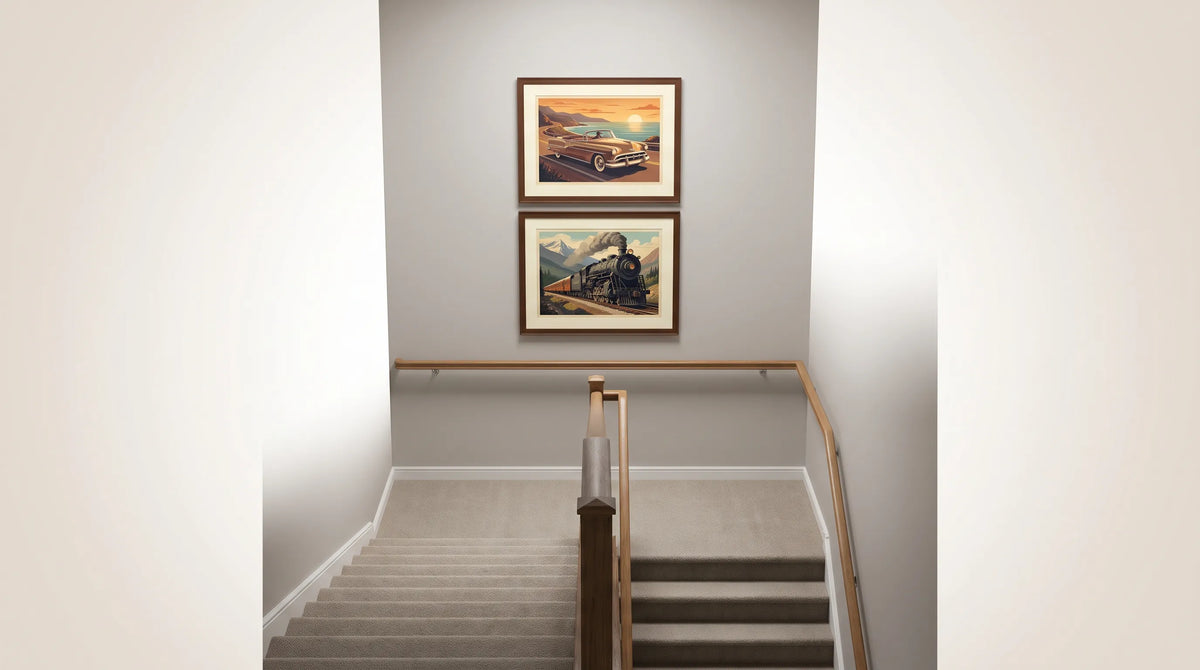
Two pieces stacked vertically can create height without requiring one oversized artwork. Keep the outer widths consistent and use a deliberate gap.
For example, two finished pieces measuring 24 inches wide by 30 inches high, with a 3-inch gap, create a composition 24 inches wide by 63 inches high. These are planning dimensions, not a statement of available product sizes.
A stepped series beside the flight
Along a sloping stair run, a small series can follow the direction of travel. Keep frame sizes or spacing consistent so the arrangement looks intentional rather than scattered.
Test the scale before making holes
Paper templates are particularly valuable when planning canvas posters for an awkward, tall space. Cut templates to the finished outer dimensions, including any frame, rather than just the printed image size.
Start with templates you can place safely from the floor or landing. Photograph the proposed arrangement from your main viewpoints and check whether the group feels substantial enough without pressing against the handrail or ceiling.
For stepped arrangements, compare the centers of the pieces with the stair’s slope. They do not have to sit on a mathematically perfect diagonal, but an accidental zigzag usually looks unsettled.
Check depth as well as width. A projecting frame near shoulder height may feel intrusive in a narrow passage, even when the front view looks balanced.
If the proposed position requires reaching over an open stairwell, use a professional installer to assess it. Do not improvise a platform or balance a ladder across steps. Hanging hardware must suit the wall construction and the complete weight of the artwork.
Coordinate color, texture and lighting
A stairwell connects rooms, so its artwork should relate to more than one nearby space. Pull a color from the entryway, upstairs hallway or stair runner rather than introducing an entirely separate palette.
For pale walls and oak treads, muted vintage transport imagery can add warmth without overwhelming the architecture. Against dark railings, monochrome vehicle artwork can repeat the metalwork’s contrast. A colorful racing subject can work as the accent in an otherwise restrained scheme.
Choose canvas posters for their composition first, then use frame finish and surrounding materials to connect them to the house. Matching every vehicle or every color is unnecessary. Repeating one strong visual element is often enough.
Check the wall in daylight and after dark. A bright window opposite the stairs can change how a glazed poster looks, while strong overhead lighting may cast shadows beneath a deep frame. Avoid sustained direct sunlight and follow the artwork’s care instructions.

Recommended Poster Pairings
Use the vehicle categories in Transit Art’s poster collections to build a pair around a shared visual quality. Compare the actual listings before ordering, since materials, proportions and available sizes may differ between designs.
Vintage car artwork with a railway print
Choose a vintage car scene and a railway subject with a similar level of detail. Two atmospheric scenes can feel cohesive even though the vehicles differ, particularly when their backgrounds share warm neutrals or subdued tones.
This pairing suits a traditional stairwell with painted woodwork or a transitional interior combining old and new furnishings. A vertical stack works well on a landing wall, provided both compositions remain readable from below.
Motorcycle artwork with a bicycle print
These subjects share an emphasis on wheels, frames and mechanical form. Select similarly composed images, such as two side views, rather than pairing a technical close-up with a busy street scene.
The combination can suit a modern staircase with simple railings and uncluttered walls. Matching outer dimensions help the two subjects read as a considered pair.
When combining canvas posters, keep at least one thing consistent: the palette, image treatment, frame finish or composition. For a larger arrangement, the principles in creating a cohesive gallery wall with framed prints help maintain that visual connection.
Carry an automotive theme into adjoining rooms
A stairwell display can introduce a transport theme without making every room look like a collection display. Smaller functional objects offer a restrained way to repeat that interest elsewhere.
The Mercedes 300 SL at Workshop - Mug depicts the classic Mercedes at a service station. The 300 SL road car debuted in 1954, bringing racing-derived engineering and distinctive design into a road-going grand tourer. Its gullwing coupe became especially recognizable, making the model a lasting favorite among collectors and enthusiasts who appreciate both mechanical innovation and elegant bodywork.
On a home-office desk or kitchen shelf, the mug can echo the interest behind an automotive wall display without adding another picture to the stairs.
The Citroen in Paris - Mug takes a more urban approach, showing a Citroën on Parisian streets. Its subject, the Traction Avant, was produced from 1934 to 1957 and helped establish front-wheel drive in large-scale European car production. Its low stance and recognizable body shape appeal to enthusiasts of French motoring and historic city scenes.
These objects belong on a suitable shelf or desk, not on stair treads or narrow railings. Let canvas posters provide the main visual statement while smaller pieces connect the theme to everyday life.
Frequently Asked Questions
Should stairwell artwork follow the angle of the stairs? A stepped series often benefits from following the direction of the flight. A single artwork or vertical pair on a landing can remain centered on that wall instead. Choose the arrangement that makes sense from the main viewing position.
How large should the artwork be? Measure the usable wall and test full-size templates. Judge the complete composition, including frames and gaps, rather than selecting a print solely because it is labeled large.
Is canvas better than a framed paper poster? Neither is automatically better. Canvas offers visible texture and is often displayed without glazing. Paper posters offer different framing possibilities. Compare reflections, depth, weight and finishing requirements for your particular wall.
Can I hang a large piece above an open stairwell myself? Only attempt installation where you have safe access and suitable equipment. For high or awkward positions, use a professional installer rather than trying to reach from the stairs.
Choose the composition before the finishing details
The strongest stairwell display has a clear relationship with the architecture. Measure first, test the arrangement and choose transport imagery that remains engaging from both near and far.
Once those decisions are settled, compare the available formats and dimensions of your shortlisted artwork. A well-proportioned piece or thoughtful pair will give a tall stairwell character without making the space feel crowded.